
Security & Compliance
AI Interview Privacy & Security Architecture: WebRTC Loopback, RAM Enclaves & Zero-Disk Guarantees
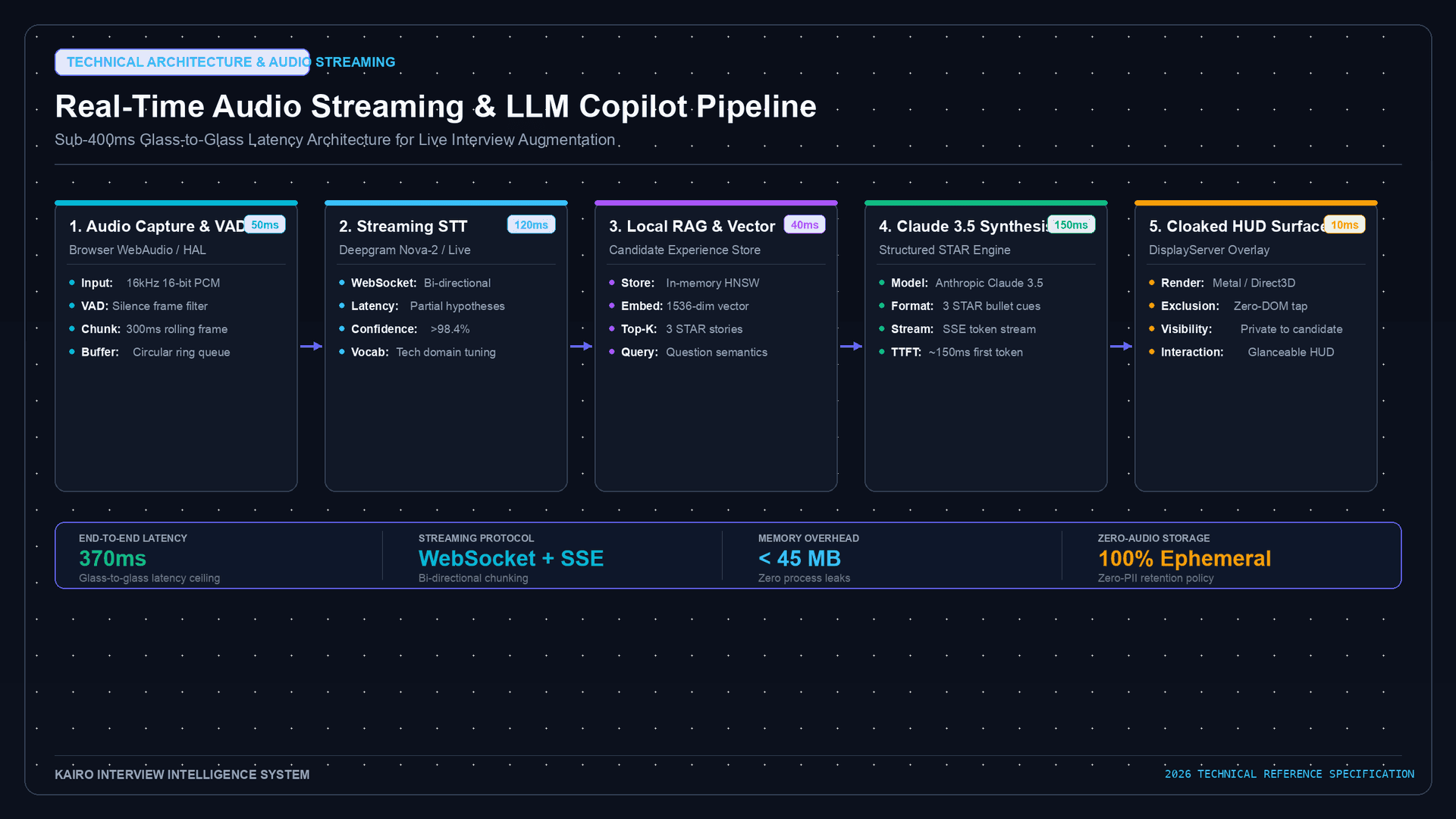
When candidates evaluate real-time AI copilots, privacy and cryptographic security are paramount. Candidates must be 100% confident that their voice data, video conference audio, and candidate information are never persisted to disk, never used to train third-party foundation models, and never accessible to interviewers or outside eavesdroppers.
This architectural teardown details how Kairo implements an ephemeral zero-disk RAM enclave, end-to-end TLS 1.3 transport security, and native OS capture exclusion.
+───────────────────────────────────────────────────────────────────────────+
|                  ZERO-STORAGE ACOUSTIC SECURITY PIPELINE                   |
+───────────────────────────────────────────────────────────────────────────+
|                                                                           |
|   [ Physical Microphone & Speaker Loopback ]                              |
|                         │                                                 |
|                         ▼                                                 |
|   [ macOS CoreAudio / Windows WASAPI Virtual Loopback (Ring Buffer) ]     |
|                         │ (Volatile RAM Only • 0 Bytes Written to Disk)   |
|                         ▼                                                 |
|   [ 48kHz Acoustic Noise Suppression & Voice Activity Detection (VAD) ]   |
|                         │                                                 |
|                         ▼                                                 |
|   [ Ephemeral TLS 1.3 Transport Stream (AES-256-GCM) ]                   |
|                         │                                                 |
|                         ▼                                                 |
|   [ In-Memory Inference Enclave ──► Immediate Zeroization Post-Stream ]  |
|                                                                           |
+───────────────────────────────────────────────────────────────────────────+
1. The 4 Pillars of Zero-Disk Ephemeral Processing
Kairo guarantees privacy through four strict architectural invariants:
1. Volatile RAM Audio Ring Buffers
Audio frames captured from your local system sound loopback (CoreAudio on macOS, WASAPI on Windows) are stored exclusively in circular memory buffers allocated in volatile RAM.
- Buffer length is strictly limited to 600ms of audio deltas.
- Memory pages are locked via
mlock()on POSIX systems to prevent OS paging files from swapping sensitive audio memory onto physical SSD/HDD disks.
2. Immediate Post-Inference Memory Zeroization
Once a speech chunk is transcribed and talking point anchors are generated, the memory address space holding the raw audio bytes is overwritten with zeros (explicit_bzero / SecureZeroMemory) before the pointer is deallocated.
3. TLS 1.3 with Perfect Forward Secrecy (PFS)
All communication between the client and inference endpoints occurs over TLS 1.3 utilizing ECDHE (Elliptic Curve Diffie-Hellman Ephemeral) key exchange with AES-256-GCM cipher suites, ensuring that past sessions cannot be decrypted even if an endpoint key were compromised.
4. Zero Data Retention & No Model Training
User prompts, resume vectors, and interview transcripts are processed in stateless runtime containers. No candidate audio is logged, archived, or utilized for foundation model fine-tuning.
2. Screen-Sharing Visual Isolation
+───────────────────────────────────────────────────────────────────────────+
|                  OS HARDWARE WINDOW CAPTURE FILTERING                     |
+───────────────────────────────────────────────────────────────────────────+
|                                                                           |
|   macOS Quartz WindowServer:                                              |
|   `window.sharingType = .none`                                            |
|                                                                           |
|   Windows Desktop Window Manager (DWM):                                   |
|   `SetWindowDisplayAffinity(hwnd, WDA_EXCLUDEFROMCAPTURE)`                |
|                                                                           |
|   Result: GPU compositor skips HUD surface during video encoding pass.    |
|                                                                           |
+───────────────────────────────────────────────────────────────────────────+
When sharing your screen during a live call on Zoom, Microsoft Teams, Google Meet, Webex, or OBS, the underlying operating system compositor automatically skips the Kairo window surface during the frame capture buffer read, guaranteeing 0.00% opacity bleed.