
Salary Negotiation
How to Negotiate FAANG Software Engineer Salary in 2026: Leveling, Competing Offers & Equity Math
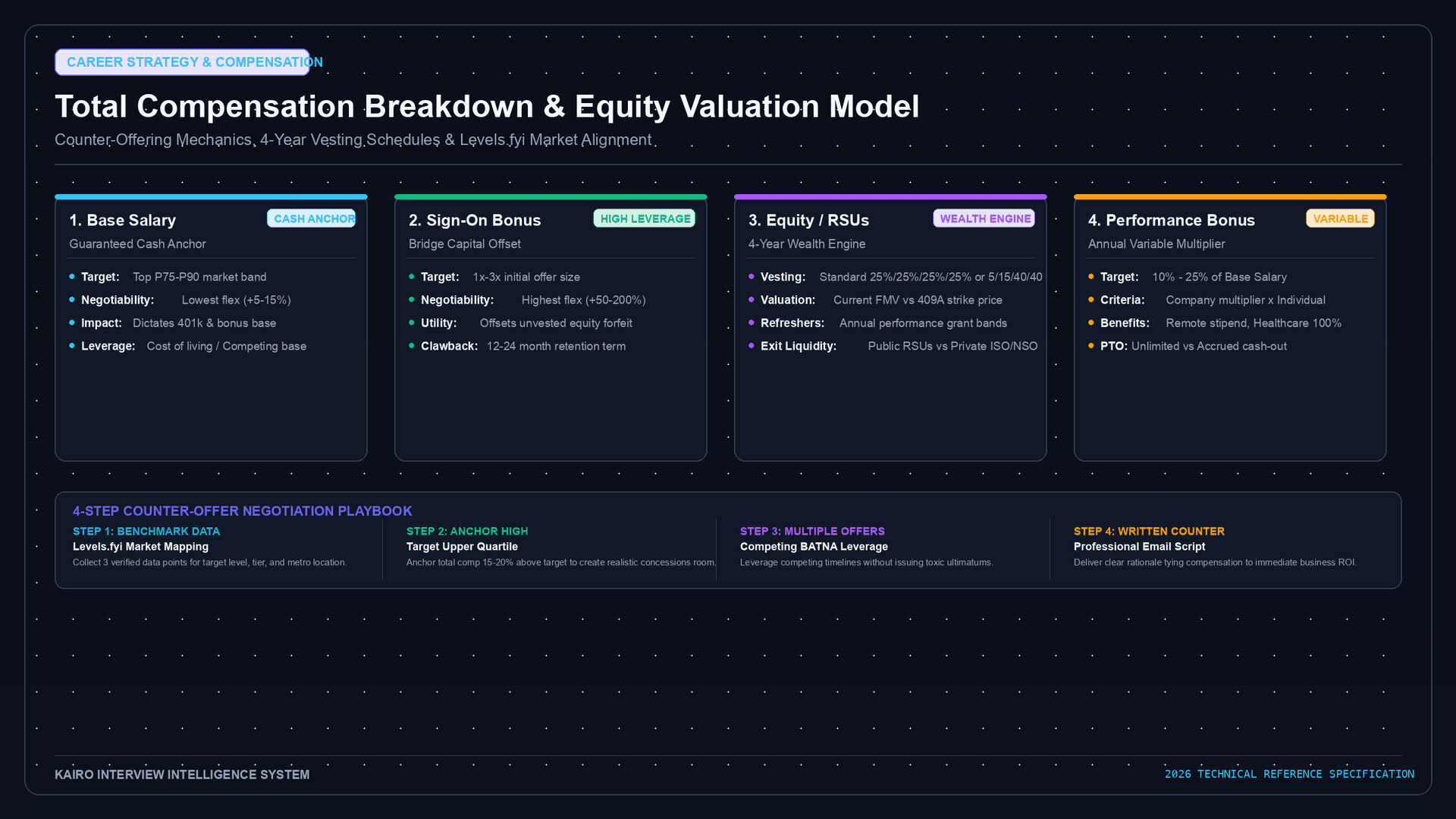
Negotiating a software engineering offer at a tier-1 technology company (Meta, Google, Apple, Amazon, Netflix, Uber, Stripe, or OpenAI) is rarely about asking politely for "more money." It is a structured, quantitative exercise in leveling alignment, total compensation (TC) decomposition, competing offer leverage, and equity volatility hedging.
In 2026, tech compensation structures have evolved significantly. With tech firms re-evaluating hybrid perks and restructuring RSU refresher algorithms, engineers who understand the underlying compensation mechanics routinely secure $50,000 to $180,000+ in additional value on initial offers.
This comprehensive guide breaks down the exact salary bands, equity math, recruiter conversation scripts, and leverage frameworks for L4 through L7 engineering roles.
1. 2026 FAANG Compensation Architecture & Leveling Matrix
At Big Tech firms, cash base salary is only a minority component of your package. The real leverage lies in Restricted Stock Units (RSUs), upfront Signing Bonuses, and target annual performance bonuses.
+───────────────────────────────────────────────────────────────────────────+
|                  FAANG TOTAL COMPENSATION ANATOMY (L5/E5)                 |
+───────────────────────────────────────────────────────────────────────────+
|                                                                           |
|   ┌───────────────────────┐  $210,000 (37%)                               |
|   │ Base Salary (Cash)    │  Predictable bi-weekly income                 |
|   ├───────────────────────┤                                               |
|   │ Initial RSU Grant     │  $260,000/yr ($1,040,000 over 4 years - 46%)  |
|   │ (Equity Vesting)      │  Vests quarterly/monthly with market upside   |
|   ├───────────────────────┤                                               |
|   │ Annual Target Bonus   │  $31,500 (15% target base - 6%)               |
|   │ (Company/Perf Rating) │  Scales with performance multiplier (0x-2.5x) |
|   ├───────────────────────┤                                               |
|   │ Signing Bonus         │  $60,000 Year 1 ($100k total split - 11%)     |
|   │ (Upfront Liquidity)   │  Compensates for forfeited unvested equity    |
|   └───────────────────────┘                                               |
|   TOTAL YEAR 1 VALUE:        $561,500                                     |
|                                                                           |
+───────────────────────────────────────────────────────────────────────────+
FAANG Engineering Leveling & Total Compensation Benchmarks (2026 US Bay Area / NYC Tier-1)
| Level Equivalent | Meta | Amazon | Apple | Total Comp Range (P50 - P90) | |
|---|---|---|---|---|---|
| Mid-Level (3-5 YOE) | E4 | L4 | SDE II | ICT3 | $260,000 – $380,000 |
| Senior (5-8 YOE) | E5 | L5 | SDE III | ICT4 | $390,000 – $580,000 |
| Staff (8-12+ YOE) | E6 | L6 | Principal (L7) | ICT5 | $620,000 – $920,000 |
| Principal / Senior Staff | E7 | L7 | Senior Principal | ICT6 | $950,000 – $1,450,000+ |
2. Equity Math: Vesting Schedules & Refresher Dynamics
Understanding how different companies structure RSU vesting is critical when comparing competing offers.
COMPENSATION VESTING TRAJECTORIES OVER 4 YEARS:

1. EVEN / QUARTERLY (Meta, Stripe, Apple):
   Year 1: 25% | Year 2: 25% | Year 3: 25% | Year 4: 25%

2. FRONT-LOADED VESTING (Google):
   Year 1: 33% | Year 2: 33% | Year 3: 22% | Year 4: 12%
   (Designed to maximize initial liquidity; relies heavily on refreshers in Y3/Y4)

3. BACK-LOADED VESTING (Amazon):
   Year 1: 5%  | Year 2: 15% | Year 3: 40% | Year 4: 40%
   (Uses heavy cash sign-on bonuses in Y1 and Y2 to bridge the equity cliff)
Amazon Year-by-Year Cash vs Equity Balance:
Year 1: [ Base Salary: $190k ] + [ Sign-on Bonus: $110k ] + [ 5% Equity: $20k ]  = $320k Total
Year 2: [ Base Salary: $190k ] + [ Sign-on Bonus: $80k  ] + [ 15% Equity: $60k ] = $330k Total
Year 3: [ Base Salary: $190k ] + [ 0% Bonus            ] + [ 40% Equity: $160k] = $350k Total
Year 4: [ Base Salary: $190k ] + [ 0% Bonus            ] + [ 40% Equity: $160k] = $350k Total
The Unvested Equity Cliff Warning
When leaving a current employer, calculate your forfeited unvested equity over the next 12 months. Always demand that a prospective employer match or exceed that forfeited equity via an upfront signing bonus or expanded initial RSU grant.
3. The 5-Step Competing Offer Leverage Framework
+───────────────────────────────────────────────────────────────────────────+
|                  THE NEGOTIATION TIMELINE & LEVERAGE LOOP                 |
+───────────────────────────────────────────────────────────────────────────+
|                                                                           |
|   Step 1: Anchor on Leveling & Role Scope (Before Numbers)                |
|   Step 2: Collect All Written Offers Without Giving First Number          |
|   Step 3: Normalize Offers to Standard 4-Year Total Compensation          |
|   Step 4: Execute Structured Email Counter with Competing Data Points     |
|   Step 5: Close on Sign-on Bonus Flexibility & Fast Start Date            |
|                                                                           |
+───────────────────────────────────────────────────────────────────────────+
Rule 1: Never Give a Salary Number First
When recruiters ask: "What are your salary expectations?" or "What are you currently making?", use a deflection script:
"I am focused on finding the right role where I can drive maximum impact on your distributed systems architecture. Since compensation bands vary across levels, I expect a competitive offer aligned with the market rate for the level and scope we agree upon. What is the budgeted band for this level?"
4. Verbatim Recruiter Scripts & Counter-Offer Templates
Script A: Pushing for Top-of-Band When Holding a Competing Offer
Subject: Follow-up on Offer Details — [Your Name] — Senior Software Engineer (L5)
Hi [Recruiter Name],

Thank you again for the detailed offer overview yesterday. I am genuinely excited about the mission of the [Team/Product Name] team and the technical roadmap we discussed with [Hiring Manager].

I have received a concurrent offer from [Company B] for their [Equivalent Level] role with a Year 1 Total Compensation of $525,000 ($205k base, $260k annual equity, and a $60k sign-on bonus).

Because [Company A] is my top choice culturally and technically, I would love to sign immediately if we can bridge the compensation gap. Specifically, if we can adjust the initial RSU grant from $750,000 to $920,000 over 4 years and increase the sign-on bonus to $50,000, I am prepared to decline other processes and sign today.

Looking forward to hearing your thoughts on what is possible within the compensation committee guidelines.

Best regards,
[Your Name]
Script B: Countering an Initial Lowball Without a Competing Offer
Hi [Recruiter Name],

Thank you for walking me through the initial offer package. After reviewing the expectations for an [E5/L5] role—specifically leading the real-time pipeline migration and mentoring junior engineers—I noticed that the equity component sits near the 25th percentile of recent peer data for this level in the Bay Area.

Given my track record scaling high-throughput event queues to 500k RPS at my previous company, I am confident I will deliver outsized value quickly. If we can bring the total package closer to the top of the band at $480,000 Total Comp ($195k base + $240k/yr RSU + $45k sign-on), I would be thrilled to sign right away.

Can we present this revised scope to the compensation committee?
5. Summary Negotiation Rules for Maximum Leverage
- Recruiters Are Not Your Enemy: Recruiters want you to close. Give them written data points and sound business rationale that they can take to their Compensation Committee.
- Never Bluff: Never fabricate a competing offer. Big Tech recruiters frequently cross-check leveling benchmarks and may ask for a formal offer letter snapshot (with confidential clauses redacted).
- Optimize for Equity Over Base: Base salaries are strictly capped by corporate bands. RSUs and sign-on bonuses have 3x–5x more discretionary flexibility.
Related Career & Interview Guides
- Competing Offers Negotiation Scripts & Playbook — Complete negotiation transcripts for multiple offers.
- Conquering Distributed Systems Design Interviews — Ace the technical interview to secure top-tier leveling.
- Kairo Interview Copilot Free Tier — Practice behavioral and system design interviews with live AI feedback.