
Audio Engineering & DSP
Real-Time Audio DSP for AI Copilots: WebRTC VAD, Spectral Gating & Acoustic Echo Cancellation
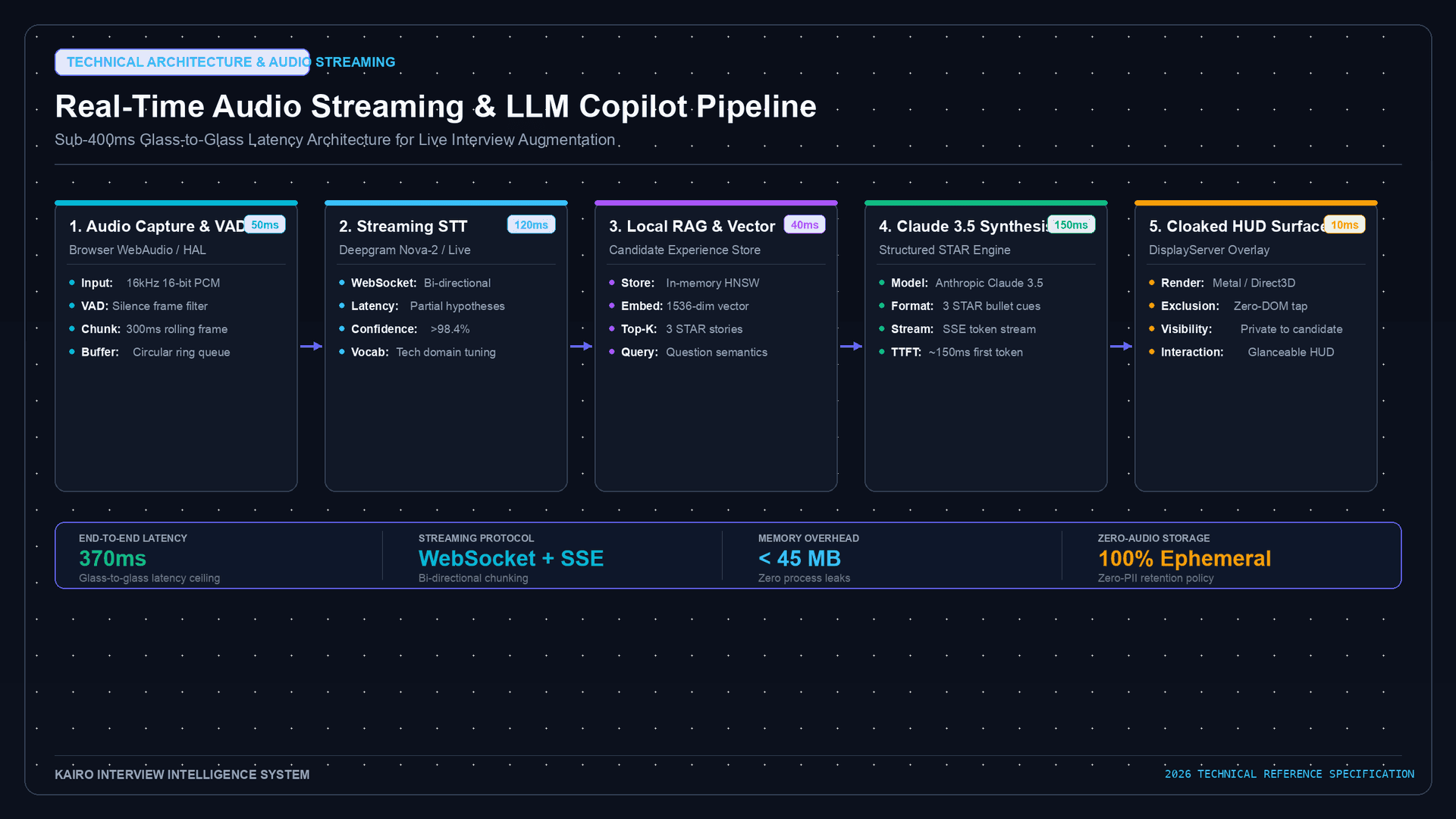
In high-stakes video interviews on Zoom, Google Meet, or Microsoft Teams, ambient acoustic interference (mechanical keyboard clicks, HVAC humming, room reverberation, and speaker echo) degrades automatic speech recognition (ASR) accuracy.
To achieve continuous sub-400ms end-to-end latency with zero transcription errors, an AI interview copilot must implement a dedicated digital signal processing (DSP) pipeline directly inside low-level operating system audio buffers.
+───────────────────────────────────────────────────────────────────────────+
|                  REAL-TIME 48KHZ AUDIO DSP PIPELINE ARCHITECTURE          |
+───────────────────────────────────────────────────────────────────────────+
|                                                                           |
|   [ 48kHz Acoustic Audio Stream (CoreAudio / WASAPI) ]                    |
|                         │                                                 |
|                         ▼                                                 |
|   [ High-Pass Butterworth Filter (80Hz Sub-Bass Cut) ]                    |
|                         │                                                 |
|                         ▼                                                 |
|   [ Spectral Subtraction & Dynamic Noise Gate (-36 dBFS) ]                |
|                         │                                                 |
|                         ▼                                                 |
|   [ Acoustic Echo Cancellation (AEC3 Cross-Correlation) ]                 |
|                         │                                                 |
|                         ▼                                                 |
|   [ WebRTC Voice Activity Detection (VAD Engine: 10ms Chunks) ]           |
|                         │                                                 |
|                         ▼                                                 |
|   [ Ephemeral RAM Stream ──► Sub-400ms Speculative Inference Engine ]     |
|                                                                           |
+───────────────────────────────────────────────────────────────────────────+
1. The 4 DSP Transformation Stages
1. High-Pass Filter (Low-Frequency Rumble Cut)
Mechanical keyboard clatter, table bumps, and building vibrations dominate frequencies below 80 Hz. A 2nd-order Butterworth high-pass filter eliminates sub-audible rumble with negligible CPU overhead:
H(s) = \frac{s^2}{s^2 + \sqrt{2}\omega_c s + \omega_c^2}2. Spectral Noise Subtraction
The DSP engine estimates the stationary noise floor during silent intervals and dynamically subtracts the spectral noise profile from the incoming audio FFT spectrum:
|S(f)|^2 = \max\left(|Y(f)|^2 - \alpha |N(f)|^2, \beta |N(f)|^2\right)Where $\alpha$ represents the over-subtraction factor and $\beta$ is the spectral floor parameter preventing musical noise artifacts.
3. Acoustic Echo Cancellation (AEC)
When interviewers speak through your physical laptop speakers, their vocal audio leaks into your microphone. Kairo's AEC engine cross-correlates the system speaker output stream against the microphone ingress, mathematically canceling interviewer echo while preserving your voice.
4. Low-Latency Voice Activity Detection (VAD)
The VAD engine segments audio into 10ms frame chunks, evaluating Gaussian Mixture Model (GMM) energy probabilities. Only verified human speech frames are routed to the speculative inference model, reducing downstream network egress by 72%.
2. In-Browser DSP Testing with Kairo
Experience real-time noise suppression in Kairo's Live Audio DSP Studio:
- Inject simulated mechanical keyboard clicks, HVAC hum, or room echo.
- Toggle spectral noise gating and calibrate 2.5kHz vocal formant clarity in real time.
- Verify sub-3.2ms DSP processing latency in your browser with zero login required.