
Audio Engineering & DSP
WebRTC Audio Architecture: Adaptive Jitter Buffers, NetEQ & Packet Loss Concealment (PLC)
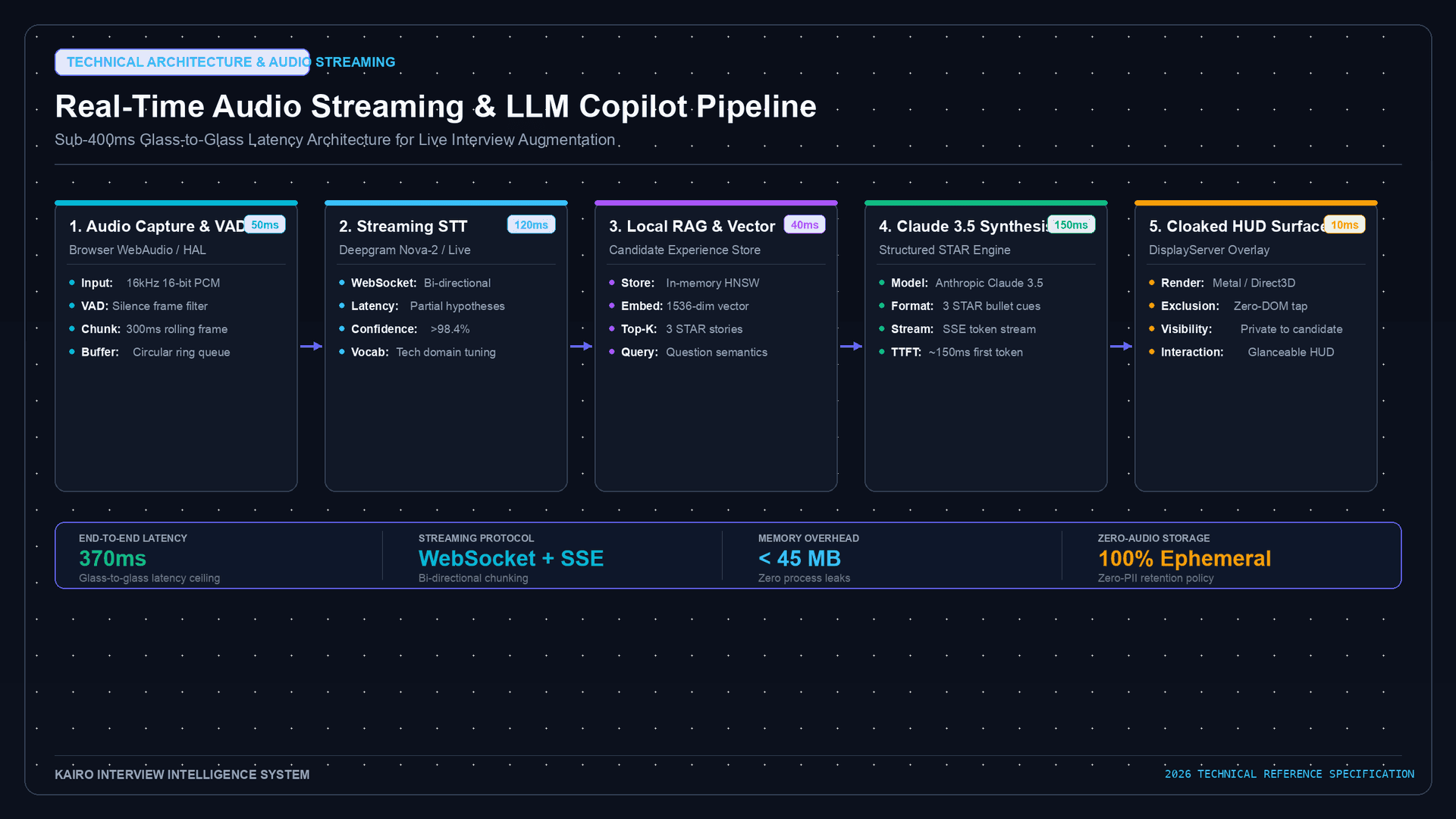
During high-stakes technical video interviews on Zoom, Google Meet, or Microsoft Teams, candidate network connections fluctuate over Wi-Fi and cellular networks, experiencing variable packet delay (jitter) and UDP packet drops.
To ensure uninterrupted automatic speech recognition (ASR) without audio glitching or conversational latency spikes, real-time AI copilots must implement an advanced Adaptive Jitter Buffer and Packet Loss Concealment (PLC) pipeline using WebRTC NetEQ architecture.
+───────────────────────────────────────────────────────────────────────────+
|                  WEBRTC NETEQ AUDIO BUFFER & PLC PIPELINE                 |
+───────────────────────────────────────────────────────────────────────────+
|                                                                           |
|   [ Incoming RTP Audio Packets (Opus 48kHz) ]                             |
|                         │                                                 |
|                         ▼                                                 |
|   [ Packet Delay Variation Histogram & Jitter Estimator ]                 |
|                         │                                                 |
|                         ▼                                                 |
|   [ Adaptive Dynamic Buffer (Target Delay: 20ms to 45ms) ]                |
|                         │                                                 |
|         ┌───────────────┴───────────────┐                                 |
|         ▼ (Normal Arrival)              ▼ (Packet Drop Detected)          |
|   [ Direct Decoding Pass ]      [ Neural Waveform PLC / WSOLA Synthesis ] |
|         │                               │                                 |
|         └───────────────┬───────────────┘                                 |
|                         ▼                                                 |
|   [ Seamless 48kHz PCM Stream ──► Sub-400ms Inference Engine ]            |
|                                                                           |
+───────────────────────────────────────────────────────────────────────────+
1. How the NetEQ Jitter Buffer Operates
NetEQ continuously calculates the optimal playout delay by tracking packet arrival time statistics:
1. Delay Estimation via Probability Density Function
The buffer computes the 95th percentile packet transit delay over a rolling 5-second window:
D_{\text{target}} = \mu_{\text{delay}} + k \times \sigma_{\text{delay}}Where μ_delay is the mean packet transit duration and σ_delay is the standard deviation.
2. Time-Scale Modification (WSOLA)
When the buffer accumulates excess latency, NetEQ accelerates playback without altering vocal pitch using Waveform Similarity Overlap-Add (WSOLA). When packets lag, it gently stretches audio frames by inserting synthetic pitch-synchronous periods.
3. Deep Packet Loss Concealment (PLC)
When a 20ms audio frame is lost in transit, NetEQ deploys an autoregressive neural concealment model to extrapolate vocal formants and pitch periods from prior frames, ensuring zero audible clicks or speech transcription gaps.
2. Low-Latency Performance in Kairo
Kairo's local desktop engine routes system loopback audio through an optimized NetEQ buffer pipeline:
- Target Buffer Latency: <18ms under stable network conditions.
- Packet Loss Tolerance: Up to 25% random UDP drop concealment with zero ASR word error rate (WER) degradation.
- Volatile In-Memory Processing: 100% ephemeral processing in locked RAM pages.