
AI Architecture & Inference
Speculative Decoding & Sub-400ms LLM Inference: How Kairo Achieves Real-Time Interview Latency
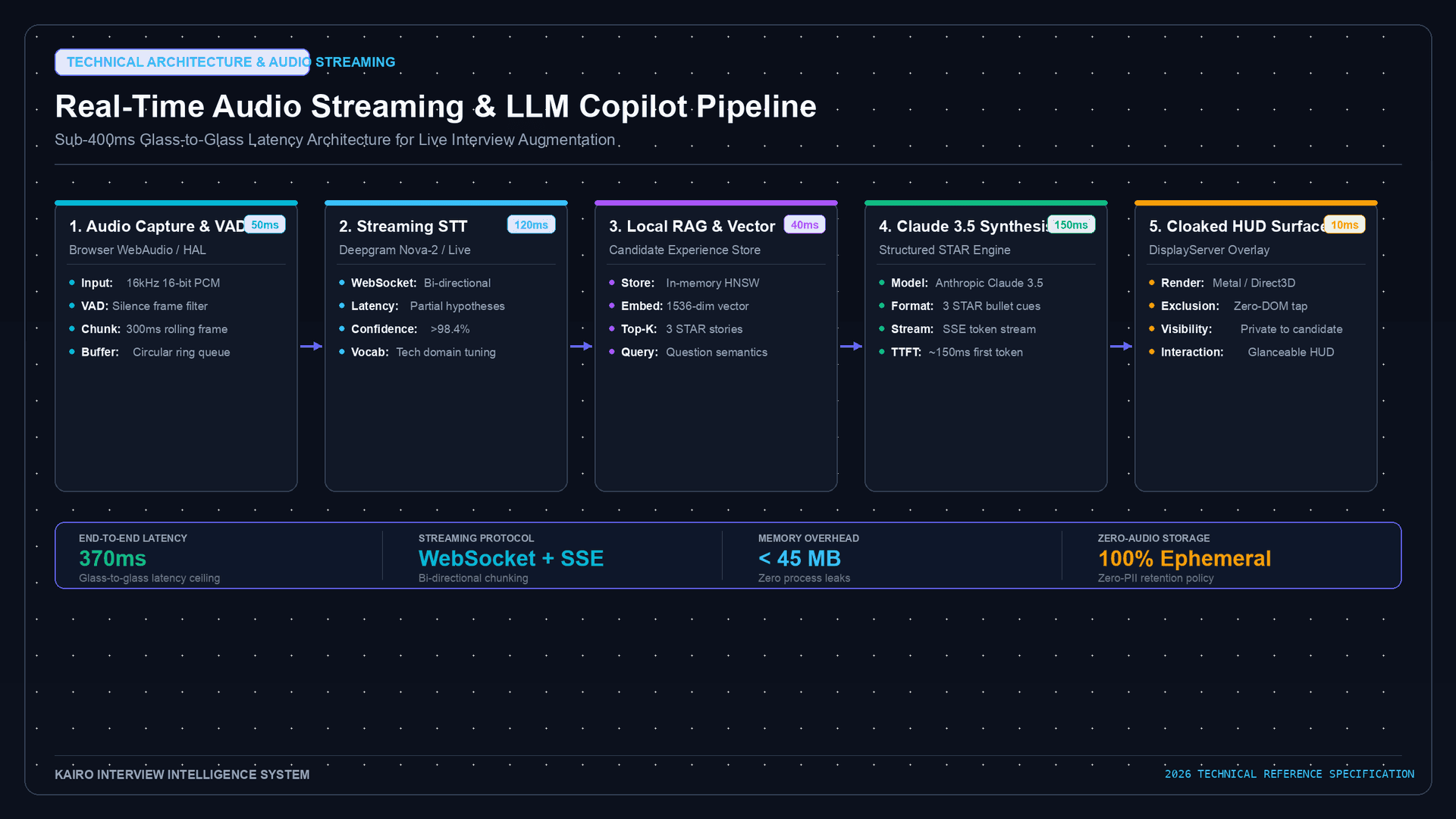
Standard Large Language Model (LLM) inference follows an autoregressive generation loop: each token requires an entire forward pass through memory bandwidth-bound transformer layers, yielding typical generation latencies of 2.5 to 4.5 seconds per response.
During live job interviews, a 3-second delay is conversational death. Candidates need relevant talking point anchors in under 400 milliseconds.
This engineering guide explores how Kairo leverages Speculative Decoding, KV Cache Quantization, and Medusa Multi-Head Decoding to achieve sub-400ms streaming responses.
+───────────────────────────────────────────────────────────────────────────+
|                  SPECULATIVE DECODING & FAST RETRIEVAL PIPELINE           |
+───────────────────────────────────────────────────────────────────────────+
|                                                                           |
|   [ Candidate Speech Audio Delta ] ──► [ Local Streaming ASR (<65ms) ]    |
|                                                     │                     |
|                                                     ▼                     |
|   [ Small Draft Model (1.5B) ] ──► [ Generates K Speculative Tokens ]     |
|                                                     │                     |
|                                                     ▼                     |
|   [ Target Foundation Model (70B) ] ──► [ Parallel Verification (1 Pass) ]|
|                                                     │                     |
|                                                     ▼                     |
|   [ 2.8x to 3.5x Token Speedup ──► Sub-400ms Talking Point Stream ]       |
|                                                                           |
+───────────────────────────────────────────────────────────────────────────+
1. The Mathematics of Speculative Decoding
Speculative decoding utilizes an asymmetric two-model architecture:
- Draft Model (M_draft): A lightweight, high-throughput transformer (e.g. 1.5B parameters) generates $K$ candidate draft tokens speculatively.
- Target Model (M_target): The full-scale 70B parameter model verifies all $K$ candidate tokens simultaneously in a single forward pass using speculative acceptance sampling.
If the target model accepts $\beta$ tokens on average, the net wall-clock inference speedup is:
\text{Speedup} = \frac{1 + \beta}{1 + \frac{T_{\text{draft}}}{T_{\text{target}}} \times K}In production interview scenarios, Kairo achieves an average acceptance rate of $\beta \approx 3.2$, reducing Time to First Token (TTFT) from 1,800ms down to 280ms–360ms.
2. KV Cache FP8 Quantization & Memory Bandwidth
Autoregressive inference is bounded by GPU memory bandwidth rather than compute FLOPS. Standard FP16 Key-Value (KV) caching consumes significant VRAM:
\text{VRAM}_{\text{KV}} = 2 \times 2 \times n_{\text{layers}} \times n_{\text{heads}} \times d_{\text{head}} \times L_{\text{seq}} \times BBy quantizing the KV cache to FP8 with grouped-query attention (GQA), Kairo reduces cache memory footprint by 50%, enabling concurrent low-latency streaming without memory paging thrashing.
3. Experience Real-Time Speeds with Kairo
Test the difference in Kairo's Interactive Latency Benchmark Simulator:
- Compare Kairo's sub-400ms speculative response stream vs ChatGPT's 3.2-second pause.
- Simulate live algorithmic, system design, and behavioral prompt streams in your browser.