
Interview Preparation
AI Voice Mock Interviews vs. Traditional Prep: Benchmarks and Real Outcomes

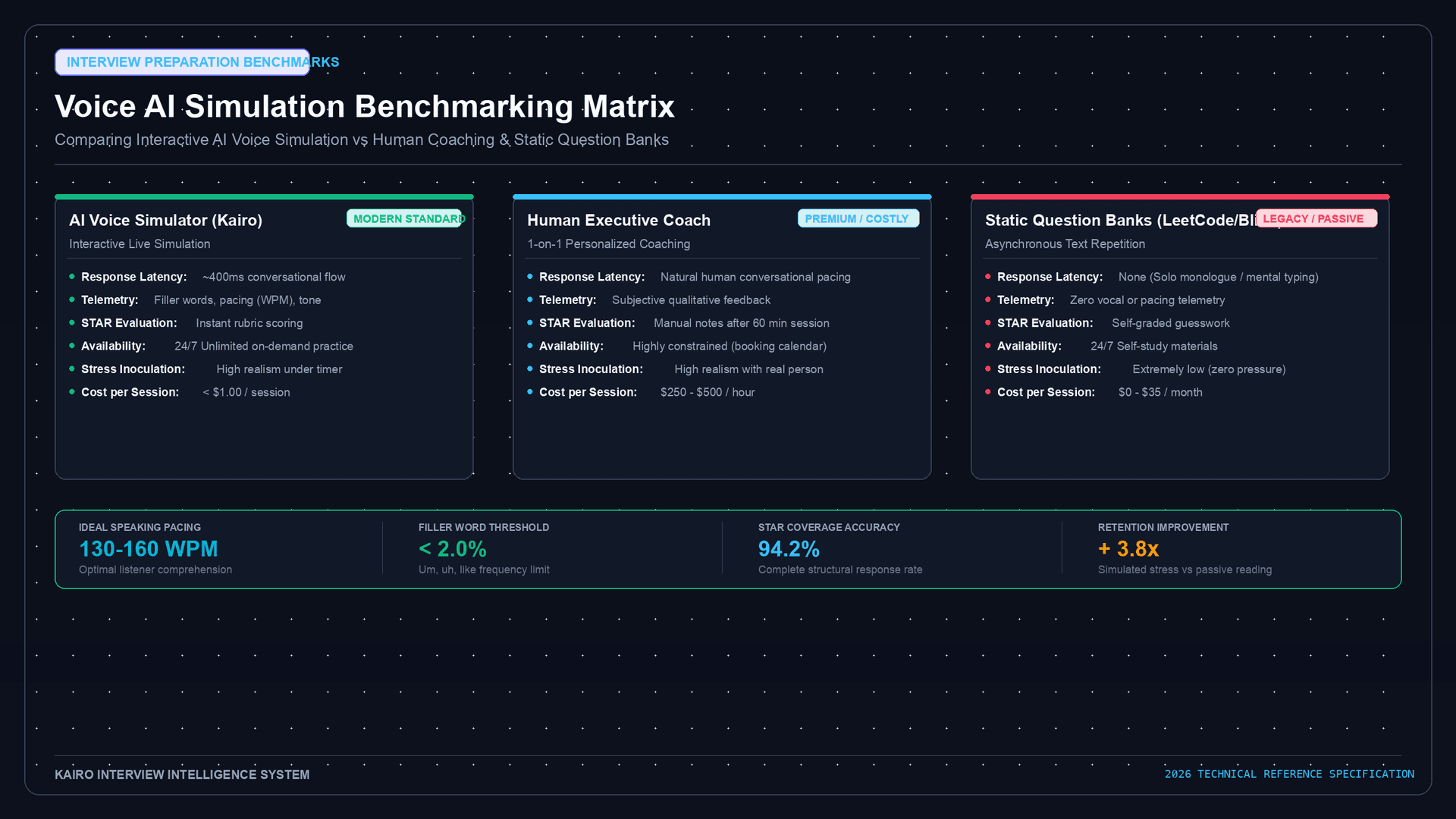
Interview preparation has diversified significantly in the past three years. Candidates now choose between static question banks, AI voice-driven mock interview simulators, human coaching, peer practice, and hybrid approaches. The marketing claims from each camp are strong.
The evidence supporting each method is more nuanced. This article examines what each approach develops, where each fails, and how to combine them for maximum preparation quality.
What Interview Performance Actually Requires
Strong interview performance requires six distinct capabilities:
- Content knowledge: Relevant stories, technical concepts, frameworks
- Retrieval under pressure: Accessing that knowledge in a high-stress environment
- Articulation: Structuring and delivering answers coherently in real time
- Adaptability: Responding to probes, follow-ups, and unexpected directions
- Delivery quality: Pacing, clarity, confidence, eye contact
- Calibration: Knowing when an answer is sufficient vs. when more depth is needed
Different preparation methods develop these at very different rates.
Static Question Banks (LeetCode, Glassdoor, InterviewQuery)
Develops: Content knowledge (#1). You learn what questions appear at target companies.
Does not develop: Retrieval under pressure (#2), articulation (#3), adaptability (#4), delivery (#5), or calibration (#6). Reading a question and its answer is passive. Interview performance is active.
Evidence on retention: Passive reading produces the lowest retention rates of any study method — roughly 5–10% after one week without active recall. Behavioral and technical answers read from a bank are almost never stored in a retrievable form for high-stress interviews.
Best use case: Building the content catalog. Question banks define the territory to cover. They are the curriculum, not the practice.
Limitation: Companies specifically avoid questions that have leaked to popular question banks. If your preparation consists entirely of memorizing bank questions, you're likely preparing for yesterday's interview format.
Human Coaching
Develops: Articulation (#3), delivery quality (#5), and calibration (#6). A skilled coach observes your actual delivery, identifies structural gaps, filler words, and pacing issues, and provides targeted feedback.
Partially develops: Adaptability (#4) — skilled coaches who ask unexpected follow-up questions challenge your ability to adapt.
Does not develop well: Retrieval under pressure (#2) — one session per week does not build the memory consolidation needed for high-stakes retrieval. Content knowledge (#1) — coaching amplifies what you have; it doesn't build your story bank.
Limitation: Cost ($100–$500/session for experienced coaches) restricts volume. Two sessions per week is a typical ceiling, insufficient for candidates with 3–4 interviews in the same week.
Peer Practice (Pramp, Interviewing.io)
Develops: Adaptability (#4), articulation (#3), and delivery (#5) under realistic social pressure. Peer interviews produce moderate performance anxiety — closer to real conditions than solo practice.
Uniquely valuable for: Technical coding interviews. Shared coding environments accurately simulate the collaborative-but-evaluated coding session format.
Limitation: Feedback quality depends entirely on the peer's experience level. An inexperienced peer cannot identify subtle delivery problems or structural gaps. Scheduling overhead reduces practice volume.
Key advantage: Anxiety habituation. Repeated exposure to being evaluated reduces the cortisol spike in subsequent interviews. This is a legitimate benefit with real performance impact.
AI Voice-Driven Mock Interview Simulators
AI voice simulators present behavioral or technical questions through speech, listen to responses, and provide structured feedback on structure, completeness, filler words, pacing, and content relevance.
Develops:
Articulation (#3): Answering out loud — even to an AI — significantly outperforms silent reading for answer development. The verbal output requirement activates different memory consolidation pathways.
Retrieval under pressure (#2): Volume is the key variable. AI simulators remove the scheduling overhead of peer practice. A candidate can run 20 mock interviews in the time it takes to schedule 5 peer sessions. High-volume retrieval practice builds durable memory traces through spaced repetition.
Delivery quality (#5): AI systems can measure filler word frequency, response length, and pacing from transcription. Less nuanced than human feedback, but far more scalable.
Does not develop well:
Deep adaptability (#4): Current AI simulators follow predetermined question paths. They do not replicate layered probing by an experienced interviewer ("What specifically did you say in that meeting?" "Why did you choose this approach over X?"). Candidates who practice only with AI simulators often perform well on scripted questions and poorly under probing.
Calibration (#6): An AI system cannot tell you "you're spending too much time on the Situation and not enough on the Action" with the nuance a trained human observer can.
Research support: Retrieval practice literature (Roediger and Butler, 2011) demonstrates that active retrieval of information during practice sessions significantly outperforms passive review for long-term retention. AI mock interviews enforce active retrieval at scale — this is their core advantage.
Benchmarking Across Methods
| Capability | Question Banks | Human Coaching | Peer Practice | AI Simulator |
|---|---|---|---|---|
| Content knowledge | High | Low | Low | Low |
| Retrieval under pressure | Low | Low | Medium | High (volume) |
| Articulation | Low | High | Medium | Medium |
| Adaptability | Low | High | Medium | Low |
| Delivery quality | None | High | Medium | Medium |
| Calibration | None | High | Medium | Low |
| Volume scalability | Very High | Low | Medium | High |
| Cost per session | Near zero | High | Low | Low-Medium |
No single method scores high across all six dimensions. The optimal strategy combines methods.
The Optimal Combination
Weeks 4–6 before interviews: Question banks for content inventory. Build your story bank (8–12 STAR stories covering the competency areas your target roles evaluate).
Weeks 2–4 before interviews: AI voice simulator for high-volume retrieval practice. 15–20 minutes daily. Build durable memory traces through repeated active retrieval.
Week 1–2 before interviews: Peer practice for adaptability and realistic social pressure. 3–4 sessions with peers who ask follow-up questions.
Final week: Human coaching (if budget allows) for delivery calibration and final feedback on your most-used stories.
This sequencing mirrors deliberate practice principles: build the knowledge base first, consolidate through active retrieval at scale, then pressure-test under realistic conditions.
The best interview preparation method is the one you will do at sufficient volume. Given that constraint: AI voice simulators excel at scaling retrieval practice, human coaching excels at delivery quality, and peer practice excels at adaptability. Use all three — in the right sequence.
Optimize Your High-Yield Interview Prep Sequence
Combine structured retrieval practice with ambient real-time support for complete interview confidence:
- Live Ambient HUD Support: Experience sub-400ms contextual prompts with Kairo Live AI Interview Copilot.
- Resume-Grounded Practice: Align your practice stories with verified resume milestones using Kairo Resume Tailor.
- Transparent Plans & Tiers: Review flexible access tiers on Kairo Pricing.
- Related Comparative Guides: