
Interview Preparation
Beating Interview Anxiety and Memory Blanking: Cognitive Psychology and Real-Time Anchors

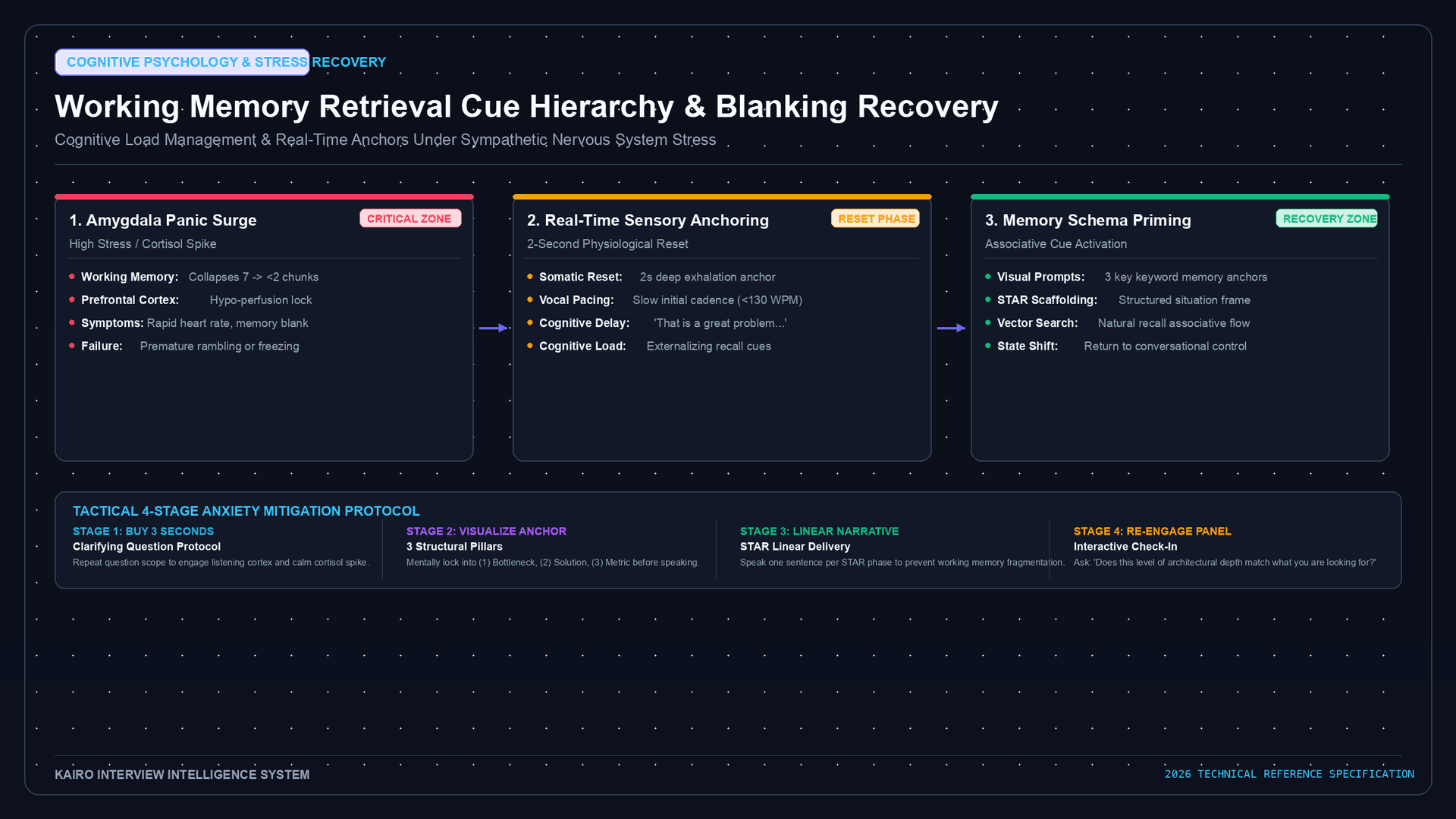
You've prepared. You know the material. You've answered this exact question out loud six times in practice. Then the interviewer asks — and your mind goes blank.
This is not a knowledge failure. It is a working memory failure under acute stress.
Understanding why memory blanking happens during interviews is the first step to building reliable counter-strategies — behavioral, structural, and technological.
The Cognitive Psychology of Interview Blanking
Working Memory and Its Limits
Working memory is the cognitive system that holds and manipulates information in real time. In a non-stressful environment, most adults can hold roughly 5–9 distinct information chunks in working memory simultaneously. These chunks support recall: you retrieve a relevant memory and manipulate it into a structured response.
Under interview stress, this capacity degrades significantly. Research on choking under pressure (Beilock and Carr, 2007) demonstrated that high-working-memory individuals — people who normally perform best on complex cognitive tasks — are paradoxically more vulnerable to performance collapse under high-stakes conditions. The mechanism: stress triggers rumination (self-monitoring thoughts like "am I performing well enough?") that consumes the very working memory resources needed for the task itself.
The Cortisol-Retrieval Interference Effect
Cortisol — the primary stress hormone — impairs hippocampal recall. The hippocampus is central to episodic memory retrieval: your ability to recall specific experiences ("what happened during that project in 2023") depends on hippocampal function. Elevated cortisol reduces retrieval accuracy and retrieval speed.
This is why the experience of blanking feels so specific: you know the answer exists somewhere, you can sense the shape of the memory — but the retrieval pathway is temporarily blocked. The memory is intact; the access is impaired.
Dual-Task Interference
Interviews impose multiple concurrent cognitive demands:
- Comprehending the question
- Retrieving relevant experiences
- Structuring the narrative
- Monitoring delivery quality (tone, pace, eye contact)
- Tracking time and response length
- Managing emotional state
When cognitive load from tasks 3–6 is high, tasks 1 and 2 (the core intellectual work) suffer. Candidates who are genuinely qualified answer poorly not because they lack knowledge but because the meta-tasks of interview performance are consuming the processing capacity needed for retrieval and articulation.
Behavioral Counter-Strategies
1. Pre-Question Anchoring (The First Sentence Protocol)
The most effective single technique for preventing blanking is to begin your answer with a concrete, specific, real anchor before anything else.
Not: "Well, thinking about this question, I'd say that there have been situations…"
Instead: "In Q2 2024 at [Company], we had a production incident that affected our largest enterprise client."
The specific anchor — time, place, event — gives working memory a concrete foothold. Once you've spoken the anchor, the associated memory network activates and retrieval becomes significantly easier. The act of speaking the anchor is itself a retrieval cue.
2. Controlled Breathing (Physiological Reset)
A double inhale through the nose followed by a slow extended exhale through the mouth — sometimes called the "physiological sigh" — is the fastest known method for downregulating acute stress response. Research from Stanford's Huberman Lab (Balban et al., 2023) found this pattern activates the parasympathetic nervous system measurably faster than other breathing techniques, reducing cortisol and heart rate within seconds.
Taking 3–5 seconds before answering to complete one slow breath cycle is not weakness — it is neurophysiology. Experienced interviewers interpret a measured pause as thoughtfulness.
3. Story Bank Retrieval Cues
A story bank without retrieval cues is harder to access under stress. Assign each story a two-word emotionally vivid "title":
- "Payment outage"
- "Design disagreement"
- "Promotion negotiation"
- "Unrealistic deadline"
Under stress, these short vivid labels are far easier to retrieve than abstract competency labels ("leadership example 3"). When you hear a behavioral question, retrieve the label first — then the story activates around it.
4. Reduction of Self-Monitoring Loops
Performance anxiety worsens when candidates monitor their own performance in real time: "Is my answer too long? Did I hesitate too much?" This self-monitoring consumes working memory.
Redirect the monitoring loop to content-tracking: "Does this answer address the Situation, Task, Action, and Result components?" Content-tracking is task-focused and keeps working memory directed at the actual work.
Structural Counter-Strategies
Pre-Interview Activation
Research on cognitive warm-up effects shows that engaging in similar cognitive tasks before a performance event improves subsequent performance. Before an interview, spend 15–20 minutes answering mock behavioral questions out loud. This pre-activates the relevant memory networks and reduces the cold-start retrieval cost in the actual interview.
Strategic Note Use
For most interview formats, having a notepad visible is acceptable and demonstrates preparation. Writing down 2–3 key structure points while the interviewer asks the question gives working memory a physical extension — offloading structure tracking to paper rather than holding it entirely in-memory.
How Real-Time Anchors Work
A real-time interview assistant functions as a cognitive prosthetic for the specific failure mode of blanking: it externalizes the retrieval task.
When a candidate blanks on a behavioral question, the failure is usually not "I have no relevant experience" but "I cannot retrieve and structure that experience fast enough under this cognitive load." A real-time copilot that displays relevant talking points — drawn from the candidate's own resume, notes, and project history — serves as an external memory buffer.
The key distinction: the copilot is surfacing the candidate's own authentic experiences, not fabricating new ones. The candidate prepared those experiences; the system retrieves them under conditions where working memory is impaired.
This is qualitatively similar to the open-note exam philosophy: open-note exams test whether you understand material well enough to apply it, not whether you can reproduce it under artificial retrieval conditions. A real-time anchor removes the retrieval bottleneck while preserving the requirement for genuine knowledge and judgment.
The Boundary Between Augmentation and Dependence
One risk of real-time anchoring tools is overcorrection: candidates who were already well-prepared stop preparing because they trust the tool to carry them. This is a mistake.
An interviewer who probes deeply — "Walk me through exactly what you said in that conversation" or "What would you do differently now?" — is asking for specific, nuanced recall that no surface-level anchor can substitute for.
Real-time anchors are most effective when used by candidates who have already internalized their own stories and experiences. The anchor doesn't replace recall; it makes impaired recall more likely to succeed. It's a floor, not a ceiling.
Interview blanking is a working memory problem under stress, not a competence problem. The counter-strategies are well-supported by cognitive science, accessible without any technology, and dramatically improved with appropriate preparation. Real-time anchoring tools extend these strategies into the live environment — for candidates who have done the preparation work to make them useful.
Build Unshakeable Recall Under Interview Pressure
Externalizing retrieval bottlenecks allows your natural competence and authentic experience to shine:
- Anchor Your Resume Milestones: Index your career achievements into structured retrieval cues using the Kairo Resume Tailor.
- Real-Time Stress Reduction HUD: Discover how live ambient cue cards prevent blanking on the Kairo Live AI Copilot and explore Kairo Pricing.
- Master Question Frameworks: Practice role-tailored behavioral scenarios in the Kairo Interview Question Bank.
- Related Reading: