
Resume Optimization
ATS Resume Keyword Optimization Guide: AI Parsers, 25+ Tech Stack Matrices & Quantifiable Metrics
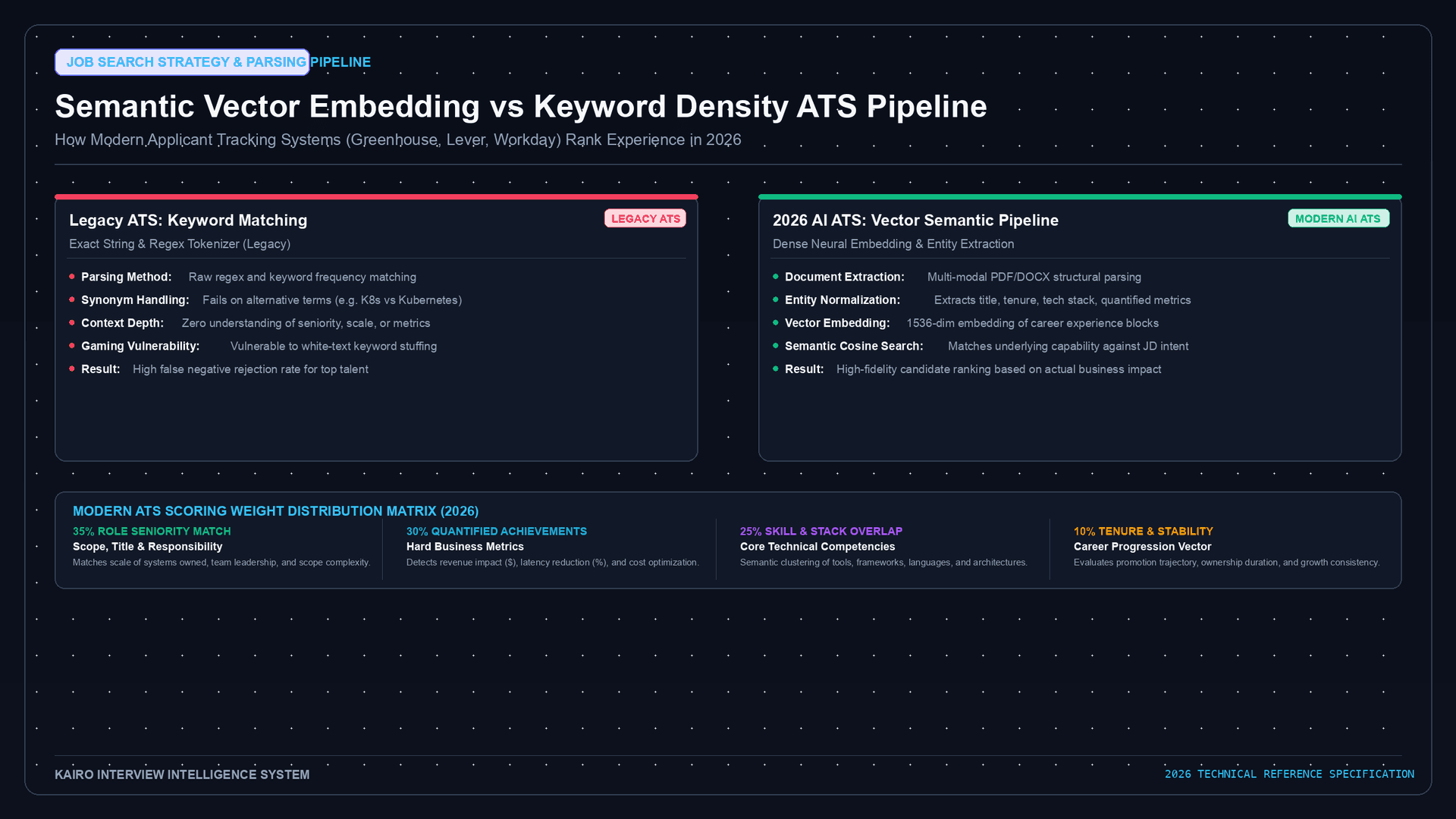
In 2026, tech job applications face an unprecedented reality: over 85% of software engineering resumes are filtered or deprioritized by Applicant Tracking Systems (ATS) and AI-driven candidate ranking algorithms before a human recruiter reads them.
Enterprise ATS platforms like Workday, Greenhouse, Lever, Ashby, and Taleo have evolved beyond primitive keyword matching. Modern systems utilize named entity recognition (NER), semantic knowledge graphs, and dense vector embeddings to compute relevance scores against job descriptions.
This guide provides an authoritative breakdown of how AI resume parsers score engineering experience, 25+ domain-specific tech stack keyword matrices, and exact formulas for maximizing quantifiable impact metrics.
+───────────────────────────────────────────────────────────────────────────+
|                  MODERN AI RESUME PARSING & RANKING ENGINE                |
+───────────────────────────────────────────────────────────────────────────+
|                                                                           |
|   Candidate PDF/DOCX Resume                                               |
|             │                                                             |
|             ▼                                                             |
|   [Optical Layout & Text Extraction Layer (OCR + PDFMiner)]               |
|             │                                                             |
|             ▼                                                             |
|   [Named Entity Recognition (NER) & Skill Graph Extraction]               |
|   - Hard Skills, Frameworks, Cloud Platforms, Tooling                     |
|   - Seniority Signals & Years of Experience (YOE)                         |
|             │                                                             |
|             ▼                                                             |
|   [Dense Vector Embedding Model (768d Semantic Representation)]            |
|             │                                                             |
|             ▼                                                             |
|   [Cosine Similarity Match vs Job Description Vector Embedding]           |
|             │                                                             |
|             ├── Score >= 0.82 ──> [Recruiter Top-Ranked Review Queue]     |
|             └── Score <  0.82 ──> [Automated Archive / Talent Pool]       |
|                                                                           |
+───────────────────────────────────────────────────────────────────────────+
1. How Modern ATS Parsers Score Your Resume
ATS platforms evaluate resumes across three distinct algorithmic tiers:
1. Structural & Entity Extraction (NER)
The parser identifies canonical section headers (Experience, Education, Technical Skills) and extracts structured key-value pairs. Using fancy multi-column visual tables, embedded text boxes, or graphical rating bars often causes the parser to corrupt chronological ordering or discard entire blocks of text.
2. Exact Keyword Density & Taxonomy Matching
ATS taxonomies map synonyms to canonical skills (e.g., "K8s" $\leftrightarrow$ "Kubernetes", "Postgres" $\leftrightarrow$ "PostgreSQL", "TS" $\leftrightarrow$ "TypeScript"). However, having both the abbreviation and full term ensures 100% match coverage across older and newer ATS platforms.
3. Dense Vector Similarity (Semantic Matching)
Modern AI screening tools embed the resume and the job description into high-dimensional vector spaces. They search for contextual semantic alignment: mentioning "designed a low-latency event stream" scores highly for a "distributed systems backend engineer" query even without an exact string match.
2. The 25+ Tech Stack Keyword Matrices for 2026
To ensure your resume passes semantic and exact-match filters, include the authoritative industry keywords corresponding to your target engineering domain:
+───────────────────────────────────────────────────────────────────────────+
|                     2026 TECH STACK KEYWORD MATRICES                      |
+───────────────────────────────────────────────────────────────────────────+
|                                                                           |
|  1. FRONTEND & WEB PLATFORMS:                                             |
|     React 19, Next.js (App Router, RSC), TypeScript, WebAssembly (WASM),  |
|     Tailwind CSS, Zustand, TanStack Query, Web Workers, Vite, Vitest,     |
|     Micro-frontends, Core Web Vitals (LCP, INP, CLS), SSR/SSG/ISR         |
|                                                                           |
|  2. BACKEND & DISTRIBUTED SYSTEMS:                                        |
|     Go (Golang), Rust, Java/Spring Boot, Python (FastAPI), Node.js,       |
|     gRPC, Protocol Buffers, Apache Kafka, Redis (Cluster, Pub/Sub),       |
|     PostgreSQL (Sharding, Citus), ScyllaDB, Distributed Tracing (OpenTel) |
|                                                                           |
|  3. ML, AI ENGINEERING & LLM INFRASTRUCTURE:                              |
|     PyTorch, Hugging Face, LangChain, LlamaIndex, vLLM, TensorRT-LLM,     |
|     Vector Databases (Pinecone, Qdrant, Milvus, pgvector), RAG Pipelines, |
|     LoRA / QLoRA Fine-tuning, Prompt Engineering, Triton Inference Server |
|                                                                           |
|  4. CLOUD, DEVOPS & PLATFORM ENGINEERING:                                 |
|     Kubernetes (EKS/GKE), Terraform, AWS CDK, Helm, ArgoCD (GitOps),      |
|     Docker, eBPF, Cilium, Istio Service Mesh, Prometheus, Grafana,        |
|     GitHub Actions CI/CD, Zero-Trust Architecture, SOC2 Compliance        |
|                                                                           |
|  5. DATA ENGINEERING & STREAM PROCESSING:                                 |
|     Apache Spark, Apache Flink, dbt (data build tool), Snowflake,         |
|     Databricks, Apache Iceberg, Delta Lake, Apache Airflow, Dagster,      |
|     Star Schema, Lakehouse Architecture, Data Lineage & Governance        |
|                                                                           |
+───────────────────────────────────────────────────────────────────────────+
3. The Google X-Y-Z Formula for Quantifiable Metrics
A resume filled with vague task descriptions ("Responsible for building APIs and working with teams") fails ATS scoring algorithms. Every bullet point must follow the Google X-Y-Z Impact Formula:
"Accomplished [X] as measured by [Y], by doing [Z]"
BEFORE (Weak & Unquantified):
- Built a microservice in Go to process user payments and connected it to Stripe.

AFTER (High-Scoring X-Y-Z Formulation):
- Architected an idempotent payment microservice in Go and PostgreSQL, processing $14M+ in monthly transaction volume with 99.995% availability by implementing Redis distributed locks and asynchronous Kafka event retry queues.
BEFORE (Vague Frontend Bullet):
- Improved website performance and fixed slow pages.
AFTER (High-Scoring X-Y-Z Formulation):
- Reduced Interaction to Next Paint (INP) from 340ms to 48ms and LCP by 52% across 2.4M monthly active users by migrating key product pages to Next.js React Server Components and code-splitting dynamic vendor bundles.4. Top 5 Formatting Rules for 100% ATS Parser Readability
- Single-Column Chronological Layout: Avoid two-column resume templates. Two-column parsers often interweave text from left and right columns into a single garbled sentence.
- Standard Section Titles: Use universally recognized headings:
Work Experience,Education,Technical Skills,Projects. Avoid creative labels like "Where I've Been" or "Toolbox". - Clean Standard Bullet Points: Use standard solid round bullet points (
•). Custom SVG icons, arrows, or checkboxes can be interpreted as unrenderable UTF-8 glyphs by older OCR parsers. - PDF or Plain DOCX Format: Export cleanly rendered vector PDFs. Do not save your resume as a flattened PNG/JPEG image inside a PDF.
- Hyperlink Context: Include clean, clickable URLs for your GitHub, LinkedIn, and personal portfolio (
https://github.com/username).
5. Automated AI Resume Tailoring Workflow
+───────────────────────────────────────────────────────────────────────────+
|               4-STEP ITERATIVE RESUME TAILORING WORKFLOW                  |
+───────────────────────────────────────────────────────────────────────────+
|                                                                           |
|   Step 1: Extract Top 15 Hard Skills from Target Job Description          |
|   Step 2: Map Existing Project Accomplishments to Target Keyword List     |
|   Step 3: Quantify Every Bullet with Metric Density (Latency, $, RPS, %)  |
|   Step 4: Execute ATS Parser Validation Scan Before Submitting            |
|                                                                           |
+───────────────────────────────────────────────────────────────────────────+
Related Career & Resume Guides
- ATS Resume Optimization for Staff and Principal Engineers — Advanced framing for senior technical leaders.
- How ATS Resume Parsers Score Experience — Deep dive into parsing algorithms and scoring weights.
- Kairo Live Interview Copilot — Prepare for your upcoming live technical interview loops with real-time AI assistance.