
Job Search Strategy
How ATS Resume Parsers Score Experience: Semantic Matching vs. Keyword Stuffing

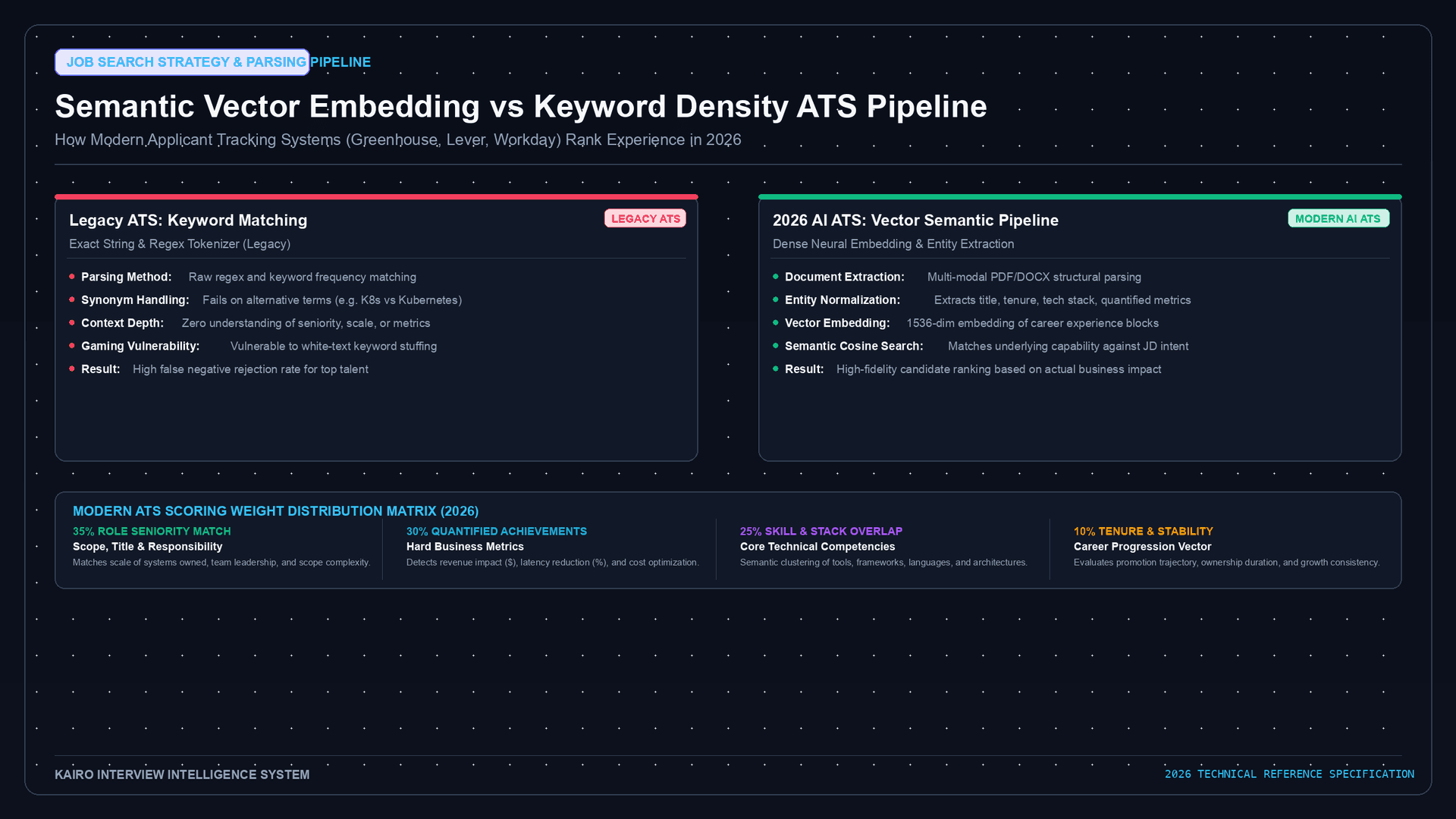
"Optimize your resume for ATS" is standard career advice, usually followed by recommendations to stuff keywords into your resume to pass automated screening. This advice was partially accurate in 2015. In 2026, it is incomplete at best and counterproductive at worst.
Modern ATS platforms — Workday, Greenhouse, Lever, iCIMS, and AI-native parsers like Eightfold, SeekOut, and HireEZ — have moved significantly beyond keyword frequency matching. Understanding what they actually do is essential for candidates who want their resumes to perform well in automated screening.
How Legacy ATS Keyword Matching Worked
The original ATS generation used rule-based extraction:
- Parse the resume into plain text
- Run pattern-matching against a keyword list from the job description
- Score by keyword hit frequency
- Rank candidates by score
Under this model, keyword stuffing worked: repeating "Kubernetes" eight times increased the Kubernetes match score. This approach had severe failure modes — a resume with "Java" could match against a "JavaScript" search, and a candidate with 10 years of experience was outscored by someone who listed the skill without any actual background.
Some enterprise organizations using decade-old Taleo deployments still exhibit these behaviors. Knowing your target company's ATS version matters.
How Modern ATS Semantic Parsing Works
Modern platforms use three overlapping techniques:
1. Entity Extraction and Taxonomy Mapping
Modern parsers extract structured entities and normalize them:
- Skills: "React.js", "ReactJS", and "React" all map to the same skill node
- Job titles: Mapped to standard seniority bands ("Staff Software Engineer" and "Principal Engineer" map to relative levels)
- Companies: Enriched with company size, industry, and prestige signals from external databases
- Duration: Time-at-role calculated from date parsing, used to weight experience depth
Taxonomy normalization solves the synonym problem that broke keyword matching.
2. Sentence-Level Semantic Embedding
The more significant shift is embedding-based matching. Modern ATS systems encode both the job description and the resume as dense vector representations (using BERT, Sentence-BERT, or proprietary fine-tuned models) and compute semantic similarity in vector space.
This means:
Synonyms match: "Developed distributed microservices" and "Built scalable service-oriented backend systems" have high cosine similarity — they describe the same work.
Context is preserved: "Led a team" has different semantic content than "worked on a team" — the embedding captures the leadership signal that keyword matching misses.
Keyword inflation provides diminishing returns: A resume with "Python" in 12 disconnected contexts does not score 12x better than one with Python in 3 contextually rich achievement descriptions. The embedding represents semantic density, not keyword density.
3. AI Ranking and Talent Intelligence
AI-native platforms like Eightfold go further: they score candidates based on inferred career trajectory, skill adjacency, and hiring pattern data from similar roles filled previously.
These systems predict fit based on:
- Skill progression over time
- Role progression and title trajectory
- Company context (experience at recognized companies in the target domain)
- Skill adjacency (do you have the adjacent skills that successful hires typically have?)
A candidate who hasn't used a specific technology listed in the job description may still rank highly if their overall skill profile matches profiles of successful hires in similar roles.
What Candidates Should Actually Optimize For
Semantic Richness Over Keyword Frequency
You don't need to use the exact phrases from the job description. You need language that describes the same work at a semantic level. Concrete, specific descriptions of real work will naturally achieve this.
Compare:
Keyword-stuffed: "Kubernetes, Docker, microservices, distributed systems, cloud architecture"
Semantic: "Designed and deployed a 40-service Kubernetes cluster on GKE, handling 25,000 requests per second with 99.9% uptime over 18 months"
The second sentence matches Kubernetes, Docker, microservices, cloud infrastructure, high availability, and distributed systems — all semantically, from one concrete bullet.
Achievement Density Over Skills Enumeration
Modern parsers score experience depth, not skills list length. A skills section with 60 tools scores worse than 15 tools where each appears in 2–3 concrete achievement contexts.
The formula: Skill mentioned + Quantified achievement = Strong signal
"Optimized PostgreSQL query performance by 65% through index restructuring and query plan analysis, reducing p99 latency from 850ms to under 300ms" signals PostgreSQL depth, database optimization, performance engineering, and quantitative impact — from one sentence.
Titles and Tenure Signal Seniority
ATS systems weight job title progression and tenure. Consistent progression with appropriate tenure scores significantly higher than identical skills across erratic short tenures.
If your title understated your actual scope (common at startups), consider a parenthetical: "Software Engineer (Team Lead, 8-person platform team)".
Summary Section: High Return for Semantic Matching
The resume summary (2–4 sentences at the top) is parsed first and weighted heavily. A strong summary describes your profile in natural language:
"Senior platform engineer with 8 years building high-throughput distributed systems in fintech and healthcare. Led infrastructure modernization programs reducing cloud spend by $1.2M annually. Expertise in Kubernetes orchestration, event-driven architecture, and cross-functional technical leadership."
This alone provides rich semantic signal for any distributed systems or platform engineering role.
File Format Matters
PDF parsing quality degrades with multi-column layouts, text in image elements, and graphics. A single-column PDF with clearly delineated sections, standard fonts, and no tables or graphics parses most cleanly across ATS variants.
What No Longer Works
Invisible keyword stuffing: Modern parsers actively filter white-on-white text and flag it as a disqualifying signal.
60-tool skills section inflation: Lower semantic density than a focused skills list with contextual evidence.
Generic achievement bullets: "Led team to success on key project" contains almost no semantic information.
Keyword mirroring without substance: Copying exact phrases from job descriptions without underlying experience is detectable through the absence of contextual evidence elsewhere in the resume.
Checking Your Resume's ATS Performance
Tools that provide direct feedback on parse quality and job description match:
- Jobscan: Parses your resume and a target job description, reports keyword and semantic match rates
- Resume.io / Rezi: ATS compatibility scoring and formatting recommendations
- LinkedIn Skills Match: Shows which required skills are present in your profile
Run your resume through at least one of these tools per application — not to stuff keywords, but to identify semantic gaps you may have missed.
ATS optimization in 2026 is not about gaming keyword frequency. It is about ensuring that concrete, specific, achievement-rich descriptions of your real work are written in language that semantic parsers can map to job requirements. This is also what makes resumes compelling to human readers. Optimizing for modern ATS means writing better resumes, not gaming worse ones.
Supercharge Your Resume for Modern Semantic Parsers
Translate your technical impact into high-density semantic keywords and quantified achievements:
- AI-Powered Resume Optimization: Match your experience to specific role requirements using Kairo Resume Tailor.
- Connect Resume Accomplishments to Live Prompts: See how Kairo retrieves resume milestones during interviews on Kairo Live AI Copilot.
- Explore Plans & Capabilities: View options on Kairo Pricing.
- Related Guides: