
Interview Preparation
Mastering STAR Behavioral Interviews: Structure, Depth, and High-Stakes Delivery

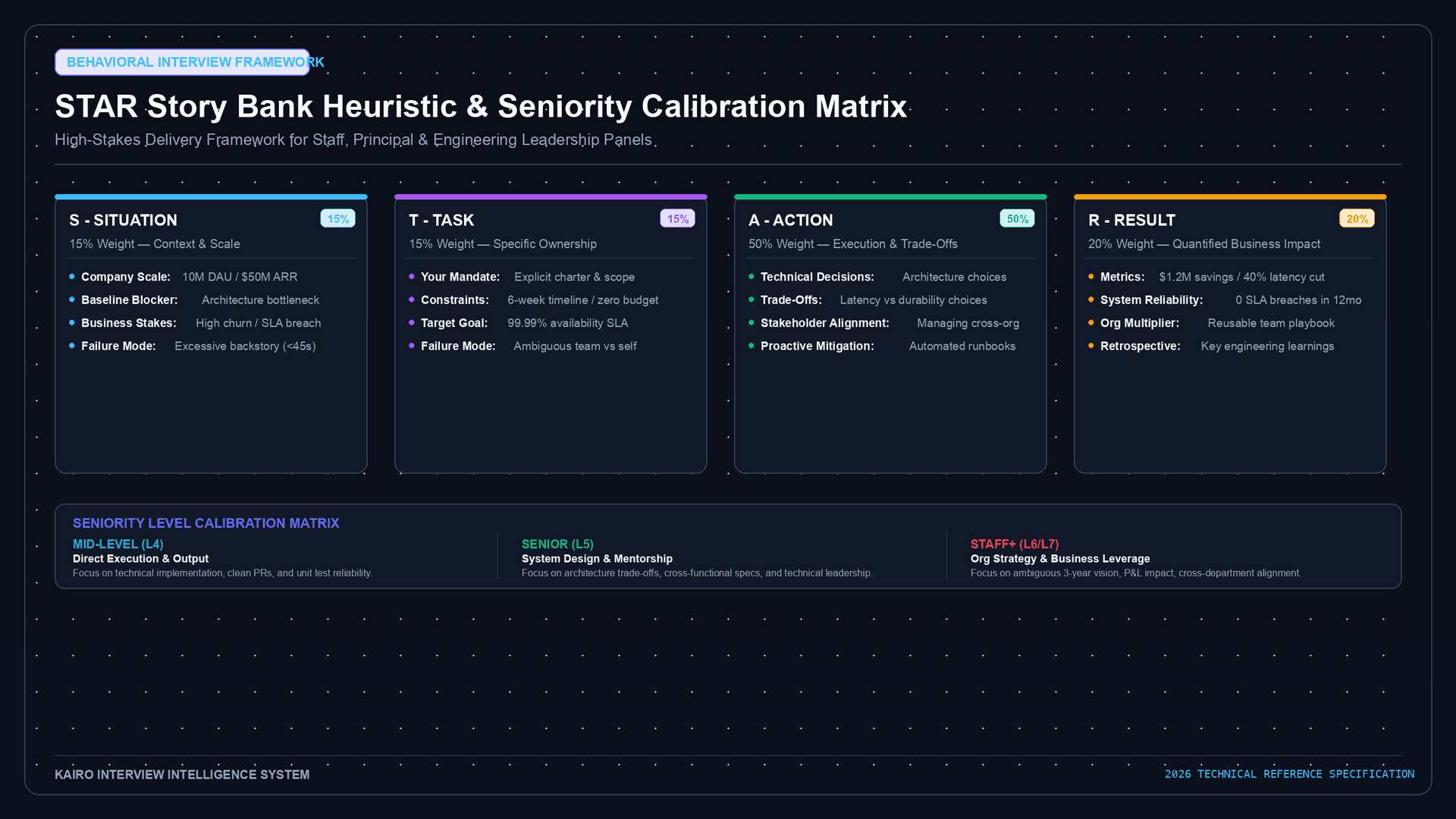
Behavioral interviews are the most widely used evaluation format across every industry, seniority level, and function. They operate on a simple premise: past behavior predicts future performance. The question "Tell me about a time when…" is not casual conversation — it is a structured evidence request.
The STAR method — Situation, Task, Action, Result — is the canonical response framework. Most candidates know the acronym. Fewer understand why interviewers use it, what they're actually scoring, and how to calibrate depth and specificity at the level that separates good answers from great ones.
Why Interviewers Use the STAR Method
Before understanding how to answer behavioral questions, understand what the interviewer is building:
A behavioral scorecard. Most structured behavioral interviews score candidates on specific competencies — leadership, ownership, communication, judgment, cross-functional influence, customer obsession. Each question maps to one or two competencies. The interviewer isn't just listening to your story; they're tagging your answer to a rubric.
Evidence, not claims. "I'm a strong communicator" is a claim. "In Q2 2024, I led a 12-person cross-functional postmortem across engineering and product after a production outage that affected 40,000 users" is evidence. Behavioral questions extract evidence that evaluators can score against a rubric.
Behavioral signal, not rehearsed pitch. Interviewers are trained to probe for specificity. Vague answers — "I generally handle conflict by…" — are red flags. Specific answers ground the interview in real events with real stakes and real outcomes.
The Four STAR Components: What's Actually Being Evaluated
S — Situation
The Situation establishes context. It should answer: where, when, who, and what was at stake.
Common mistakes:
- Too short: "I was working on a project" gives the interviewer nothing to anchor to.
- Too long: Spending 60% of your answer on backstory leaves no time for Action.
- Vague scale: "We had some challenges" vs. "We were three days from a regulatory filing deadline with an unresolved data discrepancy affecting $2.1M in reported revenue."
Target length: 2–3 sentences. The Situation is scaffolding, not the main event.
What's scored here: Relevance and proportionality. Does this story demonstrate appropriate complexity for the role level? A senior IC describing a situation a new grad would face signals ceiling.
T — Task
The Task clarifies your specific role and responsibility in the situation. This is where many candidates conflate "what the team did" with "what I did."
The interviewer needs to understand:
- What were you specifically responsible for?
- What constraints were you operating under?
- What was expected of you vs. what was ambiguous?
"Our team needed to ship the feature" is a team task. "I was responsible for the API contract design and coordinating the review with three downstream services that each had their own release calendars" is your task.
What's scored here: Scope of ownership and role clarity. This is how interviewers distinguish individual contributors from team players from leaders.
A — Action
Actions are the core of the STAR answer. This is where most candidates underinvest.
High-scoring Action sections:
- Describe what you did, not what "we" did
- Explain why you took those specific actions (your reasoning, not just your steps)
- Include tradeoffs and decisions you made, not just a sequence of tasks completed
- Acknowledge constraints or pushback you navigated
Weak Action: "I coordinated the team and got everyone aligned."
Strong Action: "I mapped out the dependencies and realized the largest blocker wasn't technical — the product manager and engineering lead had misaligned assumptions about the MVP definition. I scheduled a 45-minute working session with both, surfaced the gap using a draft spec as a concrete artifact, and we resolved the ambiguity in that session. That unblocked three engineering streams that had been in a holding pattern for four days."
The reasoning behind the action — why you did what you did, not just what you did — is what separates memorized answers from genuine behavioral evidence.
What's scored here: Judgment, initiative, leadership style, and technical or domain competence depending on the role.
R — Result
Results should be specific, honest, and bounded.
Specific: Quantify where possible. "Reduced latency by 40%", "recovered $1.2M in at-risk ARR", "improved onboarding completion from 52% to 81%."
Honest: Not every situation ends triumphantly. Interviewers at mature companies specifically probe failure and recovery. An honest result — "We shipped two weeks late, but the quality gate we instituted became the team's standard process" — demonstrates self-awareness more than inflated success stories.
Bounded: The result should answer the question that was posed. If the question was about stakeholder communication under pressure, the result should address communication outcomes, not just the technical deliverable.
What's scored here: Impact awareness, measurement orientation, and whether you can connect your actions to outcomes.
Calibrating Depth by Seniority
The same behavioral question — "Tell me about a time you influenced without authority" — should produce answers at very different scopes depending on the role being evaluated.
Individual contributor (IC 1–2): Influencing a teammate or direct collaborator. Scope: a sprint, a feature, a task.
Senior IC / Tech Lead: Influencing across teams, navigating competing priorities with peer engineers or PMs. Scope: a quarter, a project, a technical decision.
Staff / Principal: Influencing organizational direction, executive alignment, multi-team execution. Scope: half-year to multi-year initiatives, C-suite or VP stakeholders.
Manager / Director: Shaping cross-functional strategy, aligning on roadmap tradeoffs with peer leaders. Scope: org-wide initiatives, board-level context.
Under-scoping for your target level is one of the most common reasons strong candidates don't advance. Check: does your example demonstrate the full complexity of the role you're interviewing for?
High-Frequency Behavioral Questions and What They're Actually Testing
| Question | Competency Being Scored |
|---|---|
| "Tell me about a time you failed" | Self-awareness, growth mindset, psychological safety |
| "Tell me about a time you disagreed with your manager" | Professional judgment, communication, respect for authority vs. advocacy |
| "Tell me about a time you had to influence without authority" | Leadership, stakeholder management, credibility building |
| "Tell me about a time you managed a difficult teammate" | EQ, conflict resolution, coaching |
| "Tell me about a time you had to deliver bad news" | Transparency, communication, accountability |
| "Tell me about your most complex project" | Scope management, technical depth, cross-functional coordination |
| "Tell me about a time you had to move fast with incomplete information" | Decisiveness, risk calibration, bias for action |
Preparing Your Story Bank
A story bank is 8–12 pre-structured STAR stories from your career, each capable of answering 3–5 different behavioral questions with minor emphasis adjustments.
Story Bank Template
Story Title:     [Short label — "Payment outage recovery 2024"]
Situation:       [2-3 sentences with stakes, scale, timeline]
Task:            [Your specific scope and accountability]
Actions (3-5):   [Concrete steps, with your reasoning for each]
Result:          [Quantified outcomes + secondary learnings]
Competencies:    [List: Ownership, Communication, Judgment...]
Reuse As:        [List questions this story can answer]
Build 2–3 stories per major career chapter. Interview panels typically run 4–6 behavioral questions; a bank of 10 stories with good coverage across competency domains means you're unlikely to face a question your bank doesn't address.
Common Failure Modes
The team pronoun problem. "We shipped…" "Our team handled…" Interviewers can't score team behavior. They need your contribution specifically. Practice replacing "we" with "I" or "I was responsible for."
The non-answer. Describing a process ("I always try to…") instead of a specific instance. Interviewers will probe: "Can you give me a specific example?" If you can't, the question scores as no-evidence.
The humble deflection. Minimizing your role to avoid appearing boastful. "Oh, it was a team effort, I just helped where I could." This reads as lack of ownership. You're in an interview; attribute your own contribution clearly.
Over-preparation rigidity. Memorized answers that don't flex when the interviewer follows up. If your story is a script you've rehearsed word-for-word, you'll break when they probe: "What would you have done differently?" or "Walk me through specifically what you said in that conversation." Stories need to be internalized, not memorized.
The vague result. "It went really well and everyone was happy." What changed? What did you learn? How did the team or product or metric improve?
Handling Follow-Up Probes
Strong behavioral interviewers will go deep on your answer with layered follow-up questions:
- "What specifically did you say when you delivered that feedback?"
- "Why did you choose that approach over the alternatives?"
- "What would you do differently now?"
- "What did your manager think about how you handled it?"
- "How did the other person respond?"
These probes are not traps — they're calibration. The more specific you can be in response, the more credibility your original story carries. If you're vague under probing, the interviewer infers the story was embellished.
Prepare to go one level deeper on every component of each story in your bank. The follow-up question "Why did you do X rather than Y?" should not surprise you.
Delivery Under Pressure
Cognitive load in a live interview degrades retrieval. Candidates who know their stories cold in preparation sometimes blank mid-answer when the stakes are high.
Three techniques that help:
Anchor in the first sentence. Start with the concrete situation immediately: "In Q3 2024, when I was at [Company], we had a production incident two days before a major customer demo." This grounds your working memory and signals to the interviewer that a real, specific story is coming.
Use verbal signposting. "The situation was… My specific responsibility was… The action I took was… The result was…" Explicit structure reduces the cognitive demand of tracking where you are in the story.
Pause before answering. A 3–5 second pause after a behavioral question is not weakness — it's evidence of thoughtfulness. Use it to select the best story from your bank for the specific competency being probed.
The STAR method is not a formula that produces generic answers. Used well, it's a structure for delivering authentic, evidence-rich stories with enough specificity that an interviewer can verify your claims through probing. The goal is not a polished performance — it's a credible, bounded, honest account of how you actually operate.
Preparation is the prerequisite. The structure makes the preparation visible.
Turn Your Experience Into High-Scoring STAR Answers
Structuring complex past accomplishments under interview pressure is a learnable skill.
- Tailor Your Resume Milestones: Map your key career metrics directly to target job requirements with Kairo AI Resume Tailor.
- Practice Role-Specific STAR Questions: Explore structured question breakdowns across 14+ disciplines in the Kairo Interview Question Bank.
- Live Cue Scaffolding During Calls: See how structured bullet prompts support natural recall on the Kairo Live Copilot Overview and check Kairo Pricing.
- Related Preparation Deep-Dives: