
Resume Optimization
How ATS Parsers Extract Skills: SpaCy NER, Transformer Embeddings & Taxonomy Matching
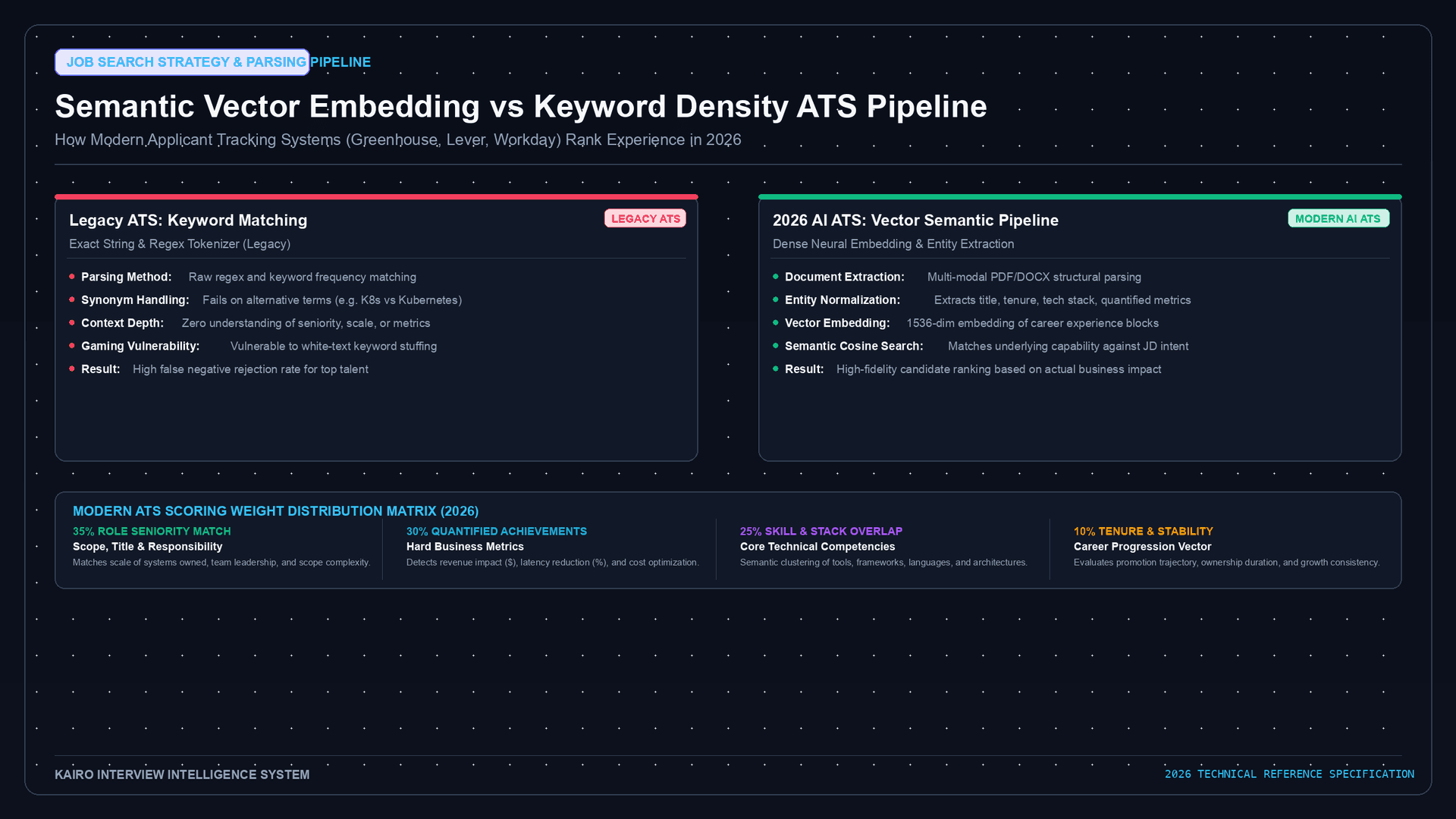
When an engineer uploads a resume to an enterprise Applicant Tracking System (ATS) such as Workday, Greenhouse, Lever, Ashby, or Taleo, the document is immediately ingested by an automated NLP extraction and ranking pipeline. Within fractions of a second, the candidate's PDF or DOCX file is converted into structured JSON, entities are classified, and a dense semantic vector is compared against thousands of applicant profiles.
Understanding the mechanics of modern resume parsers allows candidates to format their experience in alignment with parser heuristics—ensuring that senior systems architecture and domain expertise are correctly indexed rather than corrupted by parsing errors.
This guide provides an end-to-end technical breakdown of how ATS parsing engines extract skills, tokenize text, and score relevance using Named Entity Recognition (NER), SpaCy rule matchers, Transformer embeddings, and knowledge graph ontologies.
+───────────────────────────────────────────────────────────────────────────+
|                  END-TO-END ATS PARSING & RANKING PIPELINE                |
+───────────────────────────────────────────────────────────────────────────+
|                                                                           |
|   Candidate Resume (PDF / DOCX)                                           |
|         │                                                                 |
|         ▼                                                                 |
|   [1. Layout Engine & Text Extraction (PDFMiner / PDFBox / Tesseract OCR)]|
|         │                                                                 |
|         ▼                                                                 |
|   [2. Section Classification & Heading Boundary Detection]                |
|         │                                                                 |
|         ▼                                                                 |
|   [3. Tokenization, POS Tagging & Dependency Parsing (SpaCy)]             |
|         │                                                                 |
|         ▼                                                                 |
|   [4. Named Entity Recognition (NER) for SKILL, TOOL, ORG, YOE]           |
|         │                                                                 |
|         ▼                                                                 |
|   [5. Skill Graph Ontology Mapping (O*NET / EMSI / Lightcast)]            |
|         │                                                                 |
|         ▼                                                                 |
|   [6. Dense Transformer Embedding (768d Contextual Vector)]               |
|         │                                                                 |
|         ▼                                                                 |
|   [7. Dual-Score Ranker: Exact Match + Cosine Similarity vs Job Profile]  |
|                                                                           |
+───────────────────────────────────────────────────────────────────────────+
1. Document Layout Extraction & The Two-Column Trap
Before any natural language processing can occur, the parser must convert binary PDF/DOCX streams into a linear sequence of text tokens.
+───────────────────────────────────────────────────────────────────────────+
|                       THE TWO-COLUMN PARSER COLLISION                     |
+───────────────────────────────────────────────────────────────────────────+
|                                                                           |
|   PHYSICAL TWO-COLUMN LAYOUT:                                             |
|   [Column A: Skills]               [Column B: Experience]                 |
|   - Python, Go, Kubernetes         - Senior Backend Engineer at Acme Corp |
|   - PostgreSQL, Kafka, Redis       - Architected event stream processing  |
|                                                                           |
|   CRUDE HORIZONTAL SCAN CONVERSION:                                       |
|   "Python, Go, Kubernetes Senior Backend Engineer at Acme Corp            |
|    PostgreSQL, Kafka, Redis Architected event stream processing"          |
|                                                                           |
|   RESULT: Corrupted sentences; syntactic dependency trees broken.         |
|                                                                           |
+───────────────────────────────────────────────────────────────────────────+
PDF Stream Extraction Mechanics
A PDF document does not contain native concepts of "paragraphs" or "columns". It consists of coordinate-based character placement commands (BT /F1 12 Tf 72 712 Td (Text) Tj ET). Parsers use spatial clustering algorithms:
- Vertical Projection Profiles: Project bounding box coordinates onto the Y-axis to identify line breaks.
- Horizontal Projection Profiles: Calculate whitespace gaps along the X-axis to detect columnar layouts.
When a candidate uses decorative multi-column templates or tables with invisible borders, layout engines frequently merge adjacent lines across columns, completely corrupting the syntactic dependency trees required for NLP extraction.
2. SpaCy Named Entity Recognition (NER) & Skill Extraction
Once the text stream is linearized, the parser tokenizes words and runs Named Entity Recognition (NER) to extract structured attributes:
+───────────────────────────────────────────────────────────────────────────+
|                       SPACY NER EXTRACTION PIPELINE                       |
+───────────────────────────────────────────────────────────────────────────+
|                                                                           |
|   "Architected a distributed event stream in Go and Kafka handling        |
|    [----------]  [-----------------------]    [--]     [---]              |
|       VERB             EXPERIENCE             TOOL     TOOL               |
|                                                                           |
|    50,000 requests/sec with 99.99% availability at Uber from 2022 to 2026"|
|    [-----------------]      [----] [----------]    [--]      [---------]  |
|         METRIC              METRIC   METRIC        ORG        DURATION    |
|                                                                           |
+───────────────────────────────────────────────────────────────────────────+
Python SpaCy Entity Ruler & Pattern Matcher
Enterprise parsers combine deep learning NER models (Transition-based parser or RoBERTa token classification) with deterministic phrase matchers:
import spacy
from spacy.pipeline import EntityRuler

# Load base English language pipeline
nlp = spacy.load("en_core_web_trf")

# Add deterministic skill extraction ruler
ruler = nlp.add_pipe("entity_ruler", before="ner")
patterns = [
    {"label": "SKILL_BACKEND", "pattern": [{"LOWER": "distributed"}, {"LOWER": "systems"}]},
    {"label": "TECH_TOOL", "pattern": [{"LOWER": "apache"}, {"LOWER": "kafka"}]},
    {"label": "TECH_TOOL", "pattern": [{"LOWER": "kafka"}]},
    {"label": "PROGRAMMING_LANG", "pattern": [{"LOWER": "golang"}]},
    {"label": "PROGRAMMING_LANG", "pattern": [{"LOWER": "go"}]},
    {"label": "CLOUD_INFRA", "pattern": [{"LOWER": "kubernetes"}]},
    {"label": "CLOUD_INFRA", "pattern": [{"LOWER": "k8s"}]},
]
ruler.add_patterns(patterns)

doc = nlp("Architected high-throughput microservices using Go, Kubernetes (K8s), and Apache Kafka.")
for ent in doc.ents:
    print(f"Entity: {ent.text:<20} | Label: {ent.label_}")
Output:
Entity: Go | Label: PROGRAMMING_LANG
Entity: Kubernetes | Label: CLOUD_INFRA
Entity: K8s | Label: CLOUD_INFRA
Entity: Apache Kafka | Label: TECH_TOOL3. Skill Taxonomy Graphs & Synonym Resolution
An ATS does not simply perform raw string matching. It normalizes extracted terms against comprehensive knowledge graphs (such as the EMSI/Lightcast Skills Taxonomy or O*NET).
+───────────────────────────────────────────────────────────────────────────+
|                      SKILL ONTOLOGY GRAPH RESOLUTION                      |
+───────────────────────────────────────────────────────────────────────────+
|                                                                           |
|   CANDIDATE TOKENS:                                                       |
|   ["K8s", "Kubernetes", "EKS", "GKE"] ──► Canonical Node: [Kubernetes]    |
|                                                              │            |
|   PARENT CONCEPT:                                            ▼            |
|   [Container Orchestration] ◄────────────────────────────────┤            |
|          │                                                   │            |
|          ▼                                                   ▼            |
|   SIBLING SKILLS:                                            │            |
|   [Docker Swarm, Nomad, Mesos]                               │            |
|                                                              ▼            |
|                                         [Target Job Requirement Match!]   |
|                                                                           |
+───────────────────────────────────────────────────────────────────────────+
When a job description requests "Container Orchestration with Kubernetes", candidate profiles mentioning "EKS", "K8s Cluster Management", or "Helm deployments" receive ontology-derived relevance points even if the exact string phrase was not used.
4. Dense Transformer Embeddings & Semantic Scoring
Modern AI screening platforms embed entire resume bullet points and job descriptions into a shared 768-dimensional vector space using pre-trained sentence transformer models (e.g., all-mpnet-base-v2 or all-MiniLM-L6-v2).
+───────────────────────────────────────────────────────────────────────────+
|                   TRANSFORMER EMBEDDING SIMILARITY SCORING                |
+───────────────────────────────────────────────────────────────────────────+
|                                                                           |
|   Job Description Segment Vector: V_jd = Embed("Seeking backend engineer  |
|   experienced in building fault-tolerant real-time ingestion pipelines")  |
|                                                                           |
|   Resume Bullet Point Vector: V_res = Embed("Architected an event stream  |
|   in Go and Kafka processing 50k RPS with automated partition rebalancing")|
|                                                                           |
|   Cosine Similarity Match:                                                |
|   Similarity(V_jd, V_res) = (V_jd • V_res) / (||V_jd|| * ||V_res||) = 0.89  |
|                                                                           |
|   Verdict: 89% Semantic Alignment (Score >= 0.82 -> Top Priority Queue)   |
|                                                                           |
+───────────────────────────────────────────────────────────────────────────+
5. Candidate Actionable Optimization Checklist
To ensure your engineering resume receives top scores across all ATS parsers:
- Use a Single-Column Linear Hierarchy: Eliminate side-by-side columnar layouts, text boxes, and background color blocks.
- Dual-Format Abbreviations: Always provide both the common acronym and full technical name on first mention (e.g., "Kubernetes (K8s)", "Amazon Web Services (AWS)", "PostgreSQL (Postgres)").
- Embed Domain Terms Inside Actionable X-Y-Z Bullets: Avoid disconnected keyword dumping at the bottom of the page. ATS parsers weight keywords extracted within active work history bullets 3x higher than uncontextualized lists.
- Export Clean Text PDFs: Ensure your PDF preserves selectable text characters (verify by pressing
Cmd+A/Ctrl+Aand copying into a plain text editor).
Related Career & Resume Guides
- ATS Resume Keyword Optimization Guide — Complete 25+ tech stack keyword matrices and quantifiable formulas.
- ATS Resume Optimization for Staff and Principal Engineers — Senior architectural framing.
- Kairo Live Interview Copilot — Prepare for live technical rounds once your resume passes the ATS screening gate.