
Interview Preparation
Staff+ Behavioral Interview Mastery: Amazon Leadership Principles Matrix & Bar Raiser Calibration
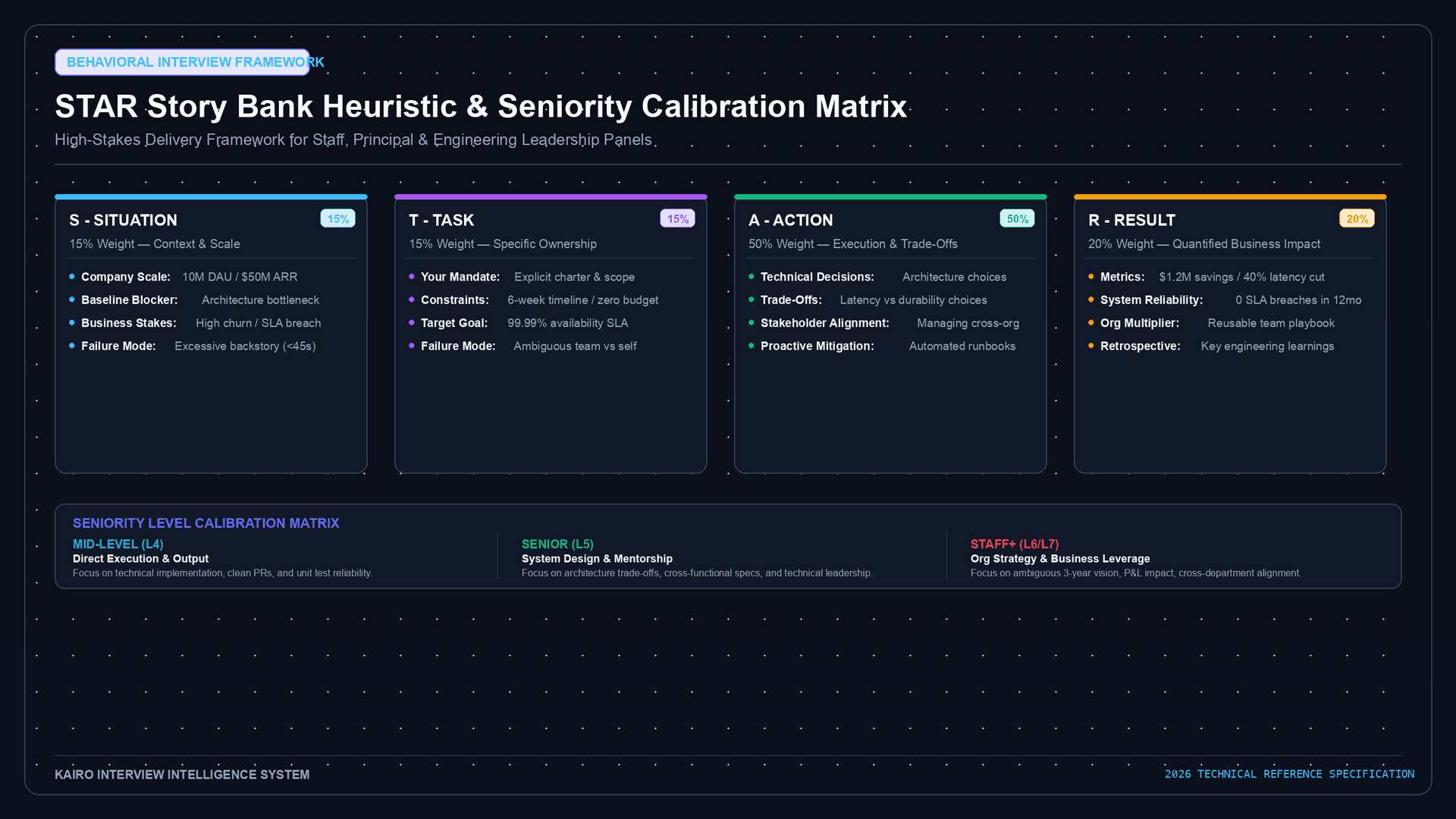
In Senior (L5/E5), Staff (L6/E6), and Principal (L7/E7) engineering interview loops at Big Tech and tier-1 startups (Amazon, Meta, Google, Apple, Stripe), the behavioral interview is often the primary gate determining level, compensation, and hiring consensus.
While junior engineers are evaluated primarily on task execution, Staff+ candidates are scrutinized for organizational leadership, decision-making under high ambiguity, conflict resolution, technical disagreement navigation, and long-term strategic judgment.
At Amazon, every hire must meet or exceed the bar set by existing employees across the 16 Amazon Leadership Principles (LPs), evaluated by an independent Bar Raiser. Other top companies (Google's Googliness & Leadership, Meta's Move Fast & Be Bold, Stripe's Think Rigorously) apply nearly identical competency matrices under different nomenclature.
This guide provides an exhaustive blueprint for structuring behavioral answers, building a reusable Behavioral Story Matrix, and passing the Bar Raiser evaluation.
+───────────────────────────────────────────────────────────────────────────+
|               BEHAVIORAL EVALUATION LEVELING PROGRESSION                  |
+───────────────────────────────────────────────────────────────────────────+
|                                                                           |
|   L4 (Software Engineer):                                                 |
|   - Delivers assigned tasks on time; demonstrates personal accountability.|
|                                                                           |
|   L5 (Senior Engineer):                                                   |
|   - Owns complex multi-quarter projects; mentors others; handles outages. |
|                                                                           |
|   L6 (Staff Engineer):                                                    |
|   - Influences cross-team strategy; drives consensus across organizations;|
|     navigates unmapped ambiguity; establishes engineering best practices. |
|                                                                           |
|   L7 (Principal Engineer / Director):                                     |
|   - Sets multi-year technical vision; aligns executives; reshapes culture;|
|     anticipates industry paradigm shifts; exhibits deep business acumen.  |
|                                                                           |
+───────────────────────────────────────────────────────────────────────────+
1. The 16 Amazon Leadership Principles (LP) Taxonomy
+───────────────────────────────────────────────────────────────────────────+
|                    THE 16 AMAZON LEADERSHIP PRINCIPLES                    |
+───────────────────────────────────────────────────────────────────────────+
|                                                                           |
|   1. Customer Obsession             9.  Bias for Action                   |
|   2. Ownership                      10. Frugality                         |
|   3. Invent and Simplify            11. Earn Trust                        |
|   4. Are Right, A Lot               12. Dive Deep                         |
|   5. Learn and Be Curious           13. Have Backbone; Disagree & Commit  |
|   6. Hire and Develop the Best      14. Deliver Results                   |
|   7. Insist on the Highest Standards15. Strive to be Earth's Best Employer|
|   8. Think Big                      16. Success and Scale Bring Broad Resp|
|                                                                           |
+───────────────────────────────────────────────────────────────────────────+
2. The CAR Method: Superior to STAR for Senior Engineers
While junior candidates use the standard STAR method (Situation, Task, Action, Result), Senior and Staff engineers should use the CAR Framework (Context, Action, Result). CAR collapses Situation and Task into a tight 30-second context, reserving 70% of response time for high-impact actions and quantifiable outcomes.
+───────────────────────────────────────────────────────────────────────────+
|                       THE CAR FRAMEWORK TIME ALLOCATION                   |
+───────────────────────────────────────────────────────────────────────────+
|                                                                           |
|   [0:00 - 0:30]  CONTEXT (15-20%):                                        |
|   - High-level business stakes, baseline metrics, and core constraint.    |
|   - "At Acme, our payment ingestion service suffered 2.8% error spikes    |
|      during Black Friday, putting $4.2M in hourly transactions at risk."  |
|                                                                           |
|   [0:30 - 2:00]  ACTION (60-65%):                                         |
|   - Specific technical decisions, cross-functional persuasion, trade-offs.|
|   - Explicit use of "I" vs "We" to delineate your personal contributions. |
|   - "I audited the PostgreSQL connection pool saturation, discovered...   |
|      I designed an asynchronous Kafka event buffering layer...            |
|      I convinced the VP of Infra to approve emergency Redis provisioning."|
|                                                                           |
|   [2:00 - 2:45]  RESULT & LEARNINGS (20%):                                |
|   - Quantifiable business impact and durable organizational changes.       |
|   - "Dropped error rates from 2.8% to 0.001%, protected $18M in GMV,     |
|      and standardized distributed rate limiting across 14 backend teams." |
|                                                                           |
+───────────────────────────────────────────────────────────────────────────+
3. The 6-Story Behavioral Matrix
Rather than memorizing dozens of separate anecdotes, build a 6-Story Matrix. Prepare 6 deeply detailed, high-scope career stories. Each story can be dynamically pivoted to answer 3-4 distinct leadership competencies.
+─────────────────────────────────────────────────────────────────────────────────────────────────────────+
| Anchor Story Title       | Primary LP / Competency        | Secondary Pivot 1          | Secondary Pivot 2          |
+──────────────────────────+────────────────────────────────+────────────────────────────+────────────────────────────+
| 1. The P0 Outage Recovery| Dive Deep                      | Bias for Action            | Customer Obsession         |
| 2. Architectural Re-write| Have Backbone; Disagree/Commit | Invent and Simplify        | Are Right, A Lot           |
| 3. Multi-Org Cross-Align | Earn Trust                     | Think Big                  | Ownership                  |
| 4. Underperforming Mentee| Hire and Develop the Best      | Insist on Highest Standards| Strive to be Best Employer |
| 5. Scrappy Migration     | Frugality                      | Deliver Results            | Learn and Be Curious       |
| 6. Failed Project / Pivot| Ownership & Resilience         | Are Right, A Lot (Post-Rev)| Customer Obsession         |
+─────────────────────────────────────────────────────────────────────────────────────────────────────────+
4. Deconstructing the Toughest Staff+ Behavioral Questions
Question 1: "Tell me about a time you had a fundamental disagreement with a senior leader or peer."
- Target LP: Have Backbone; Disagree and Commit + Earn Trust.
- The Pitfall: Portraying the other party as incompetent, or claiming you "convinced them you were right" without objective data.
- The Winning Formula:
- Explain the divergence in technical vision using objective trade-off criteria (latency vs operational overhead).
- Describe how you built a rapid prototype or gathered benchmark telemetry to replace opinions with facts.
- Detail how, once a final decision was reached, you committed 100% to the execution—regardless of whether your proposal won.
Question 2: "Tell me about a time you made a critical mistake or a project failed under your watch."
- Target LP: Ownership + Insist on the Highest Standards.
- The Pitfall: Choosing a fake failure ("I worked too hard") or blaming external vendors / junior engineers.
- The Winning Formula:
- Select a real technical or operational failure with measurable consequences.
- Take direct, unhedged personal ownership of the root cause (e.g., missing automated canary gates).
- Highlight the immediate containment actions you took during the crisis.
- Conclude with the systemic organizational safeguards you instituted to ensure the failure mode can never reoccur.
5. The Bar Raiser Scoring Rubric
Bar Raisers evaluate candidates on a 4-point calibration scale:
+───────────────────────────────────────────────────────────────────────────+
|                      BAR RAISER SCORING CALIBRATION                       |
+───────────────────────────────────────────────────────────────────────────+
|                                                                           |
|   1. STRONGLY INCLINED:                                                   |
|      Exceeds level expectations across all LPs; provides deep quantifiable|
|      evidence; exhibits profound self-awareness and architectural vision. |
|                                                                           |
|   2. INCLINED:                                                            |
|      Meets level bar; demonstrates solid execution and good LP alignment; |
|      no severe anti-patterns or red flags.                                |
|                                                                           |
|   3. NOT INCLINED:                                                        |
|      Fails to demonstrate required scope; overly passive ("we" without "I")|
|      defensive when pressed on technical depth; hand-waves failure cases.  |
|                                                                           |
|   4. STRONGLY NOT INCLINED:                                               |
|      Blames colleagues; demonstrates low integrity or lack of ownership;  |
|      cannot explain systems they claim to have designed.                  |
|                                                                           |
+───────────────────────────────────────────────────────────────────────────+
Related Career & Interview Guides
- Mastering STAR Behavioral Interviews in Tech — Foundational framework and behavioral mechanics.
- Executive and Leadership Interview Playbook — Strategies for Staff, Principal, and VP candidates.
- Kairo Live Behavioral Copilot — Practice real-time storytelling with an AI interview copilot providing sub-400ms talking points.