
Career Strategy
Executive and Leadership Interview Playbook: Strategic Impact, Scaling Teams, and Stakeholder Alignment

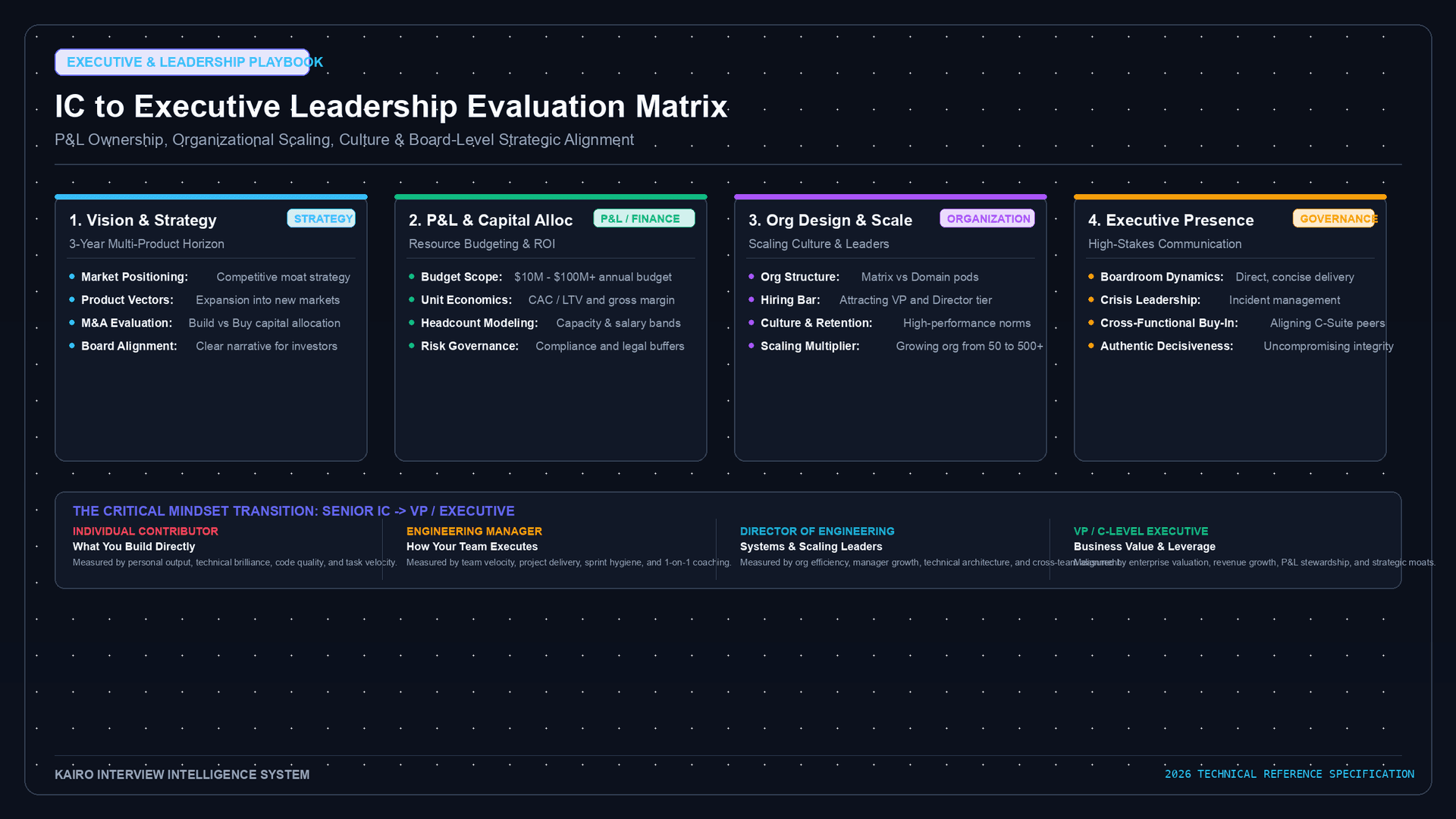
Executive and senior leadership interviews operate on a fundamentally different evaluation model than individual contributor interviews. The questions are broader, the answers demand larger scope, and the evaluators are assessing whether you can operate at organizational scale — not just whether you can do the job.
A VP of Engineering candidate who answers behavioral questions at Senior Engineer depth will not pass. A Director candidate who cannot articulate business impact in financial terms will struggle with CFO or COO-level interviewers. This playbook covers the specific competencies, answer frameworks, and communication strategies required at VP, Director, C-suite, and equivalent leadership levels.
The Evaluation Model at Senior Levels
Executive interviewers are assessing qualitatively different questions:
At IC level: Can you do this specific work?
At Senior/Staff level: Can you do this work better than peers and mentor others?
At Director level: Can you build and direct a team that does this work reliably and at scale?
At VP/C-suite level: Can you define what the work should be, build the organization to do it, and measure whether it's creating business value?
Scope, autonomy, business impact, and organizational leadership are the axes — not technical depth.
Communicating Strategic Impact
The most common failure mode for strong IC candidates at Director+ levels is communicating impact at the wrong level of abstraction.
IC-level impact: "I built a distributed caching layer that reduced latency by 45%."
Director-level impact: "I led the migration to a distributed caching architecture that reduced latency by 45%, which improved checkout conversion by 3.2% — approximately $4.2M in incremental ARR. The project required coordinating three engineering teams across a six-month roadmap."
VP-level impact: "I identified that our infrastructure posture was becoming a competitive risk as we scaled from 5M to 50M users. I built the business case for a $2.4M modernization program, secured executive budget, hired a 12-person platform team, and delivered in 14 months. We reduced infrastructure spend by 28% and improved uptime from 99.7% to 99.97%."
Rule: At Director and above, every impact statement should include a financial or business metric and a description of the organizational scope you owned.
Scaling Teams: What the Interviewer Is Evaluating
Leadership candidates are routinely assessed on their ability to build, scale, and lead organizations. Key competency dimensions:
- Hiring and talent strategy: How do you attract and develop strong talent?
- Culture and performance management: How do you establish standards and hold people accountable?
- Organizational design: How do you structure teams for the work to be done?
- Developing leaders below you: How do you scale your own impact by growing leaders on your team?
"Tell me about a time you scaled a team rapidly" — Tests judgment under hiring pressure, standards maintenance, onboarding systems, and the structural decisions that enable fast growth without chaos.
A strong answer covers: your hiring philosophy, how you maintained bar under timeline pressure, the onboarding program you built, and the organizational structure decisions (team size, span of control, sub-team formation) you made as headcount grew.
"Tell me about a time you had to let someone go" — Tests accountability, performance management rigor, fairness, and willingness to make hard decisions.
A strong answer shows process: documentation, performance improvement plans, clear feedback timelines, and why the decision was ultimately right for the team and the individual.
"How do you build a high-performing culture?" — Tests whether you have a coherent philosophy or just platitudes. "Hire smart people and get out of their way" is a platitude. Describe specific practices: how you run team rituals, what you celebrate and what you correct, how you handle failure vs. risk-taking.
P&L, Budget, and Financial Fluency
Executive candidates need to understand, manage, and discuss budgets, unit economics, and return on investment.
Key concepts to demonstrate:
Headcount planning: "I planned a $4.2M annual headcount budget across 35 engineers, including a $1.1M contractor line for Q3/Q4 peak capacity."
Build vs. buy ROI: "We modeled the $300K/year SaaS cost against $1.2M in build cost — 9 months of 3 senior engineers — with an expected 4-year lifespan. We chose to build given the differentiation value and existing team capacity."
Cost of delay: "We quantified the reliability problem at approximately $120K/month in customer credits, support overhead, and estimated churn. That made the $800K remediation investment an easy case to executives."
If you don't have direct P&L ownership, prepare 2–3 examples where you constructed a business case, estimated costs and benefits, and secured stakeholder alignment on a significant investment.
Cross-Functional Influence and Stakeholder Alignment
At Director and above, most of what you accomplish happens through influence rather than authority. Evaluators want evidence that you can:
- Align people with competing incentives toward a shared goal
- Navigate organizational politics without becoming political
- Build coalitions across functions without formal authority
- Communicate effectively up (board and C-suite) and down (teams)
"Tell me about a time you drove alignment across functions with competing priorities" — A strong Director+ answer:
- Names the specific organizational conflict (e.g., Engineering wants to pay technical debt; Product wants new features; Sales needs a specific integration for a major enterprise deal)
- Diagnoses the root conflict — what was each function optimizing for?
- Shows the alignment mechanism (joint working session, shared metrics, phased approach that addressed multiple needs)
- Demonstrates the outcome in terms of what each function received and the business result
The Leadership Philosophy Question
Every senior interview includes some version of "What is your leadership philosophy?"
Weak answers: "I believe in empowering my team" / "I'm a servant leader" / "I hire people smarter than me." These are platitudes that score poorly because they reveal nothing distinctive.
Strong answer structure: Philosophy → Mechanism → Specific practices → How it handles the hard cases.
Example: "I believe leaders create clarity — clarity on goals, constraints, and what success looks like. When my team is stuck or in conflict, the root cause is almost always ambiguity about one of those three things. In practice, I invest heavily in goal-setting rituals — quarterly OKR reviews, explicit success metrics, documented assumptions — and manage by outcome, not process. When someone isn't delivering, I look first at whether I failed to provide the clarity they needed before assuming it's a performance issue."
This names a philosophy, explains the mechanism, describes the practices, and shows how it handles a hard case (underperformance). That is specific, credible, and distinctive.
Board-Level Questions
Director and VP candidates at PE-backed or public companies may interview with board members. Board interviewers evaluate strategic judgment, fiduciary awareness, and enterprise risk thinking.
"What's the biggest risk to this business you'd address in the first 90 days?" — Tests strategic analysis and courage to give a real opinion rather than a hedge. Research the company. Have a genuine view. State it with conviction.
"How do you think about the tradeoff between growth and profitability at your current stage?" — Tests financial maturity and strategic alignment. Know where the company is in its growth trajectory and have a perspective on the right balance for the business model.
"Tell me about a decision you'd reverse if you had the chance." — Tests self-awareness and intellectual honesty. Board interviewers detect candidates who cannot acknowledge mistakes. Have a genuine, significant example — not a small tactical misstep, but a real strategic call you got wrong and what you learned.
Delivery With Authority
Executive presence is about pacing, conviction, and the willingness to disagree.
Experienced executive evaluators are not impressed by candidates who agree with everything. They look for people who take a position and defend it, acknowledge uncertainty without being indecisive, and respond to challenges without defensiveness.
Answer the question first, then provide context:
"What would I change in the first 90 days? The enterprise customer onboarding experience. I'd prioritize that over everything else, and here's why…" — This is executive delivery.
"Well, there are many factors and it's difficult to say without knowing more about the specific situation, but generally speaking I'd probably look at several areas…" — This is not.
Senior and executive interviews reward candidates who have internalized the shift from individual execution to organizational leadership — and can demonstrate that shift through concrete, specific, financially-grounded examples. The preparation work is real. The story-building is real. The delivery practice is real. The payoff at Director and above is proportional to the stakes.
Excel in Executive, Director, and VP Panel Interviews
Demonstrate enterprise vision, P&L ownership, and strategic clarity with structured delivery:
- Live Strategic Memory Retrieval: Discover how ambient cue cards assist executive recall on Kairo Live AI Copilot.
- Executive Profile Alignment: Tailor your executive narrative and board-level achievements using Kairo Resume Tailor.
- Select Your Executive Prep Plan: Compare tiers and features on Kairo Pricing.
- Related Executive Strategy: