
Career Strategy
Salary Negotiation Strategies for Tech Offers: Counter-Offering, Equity Math, and Total Compensation

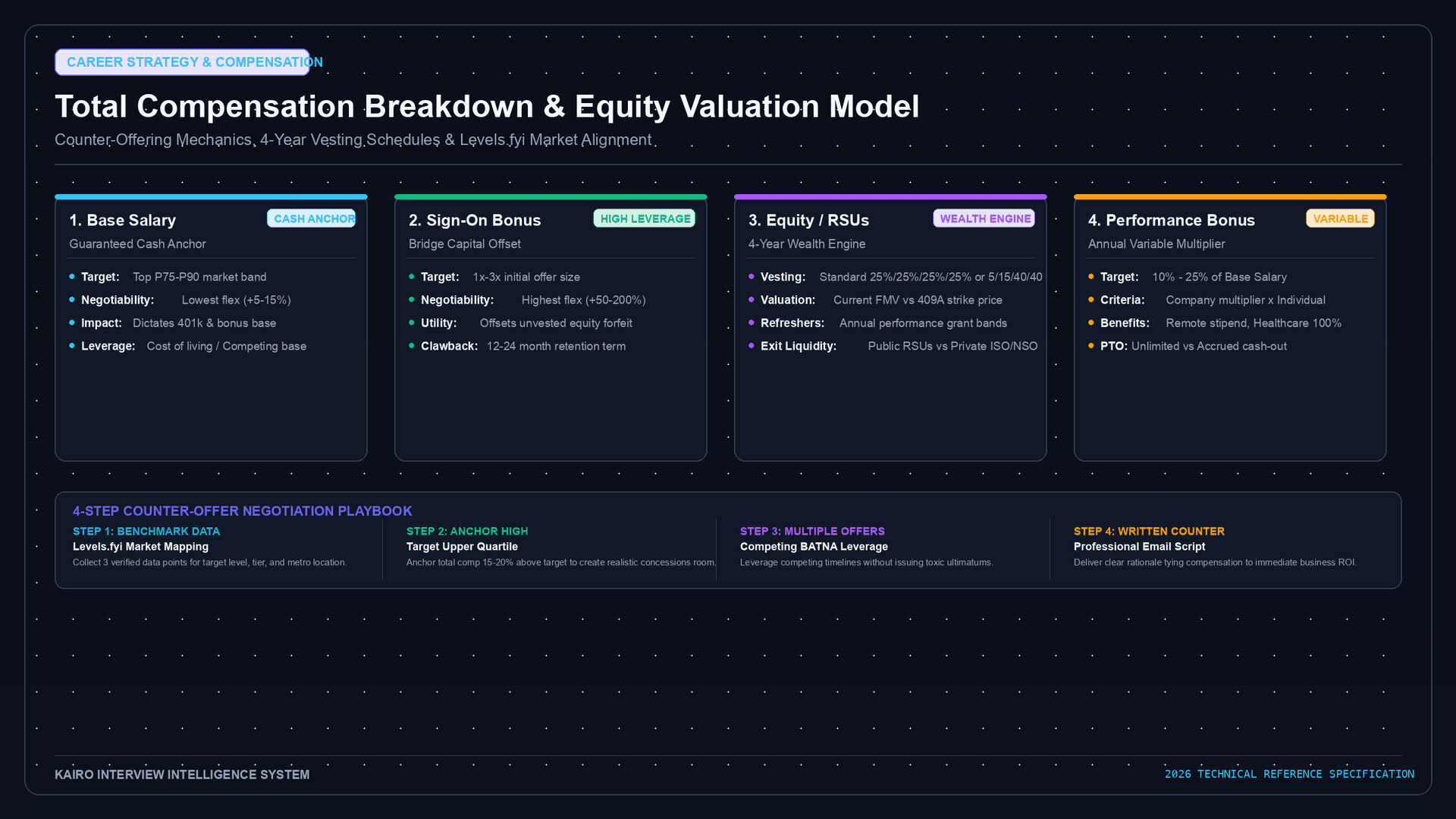
Most tech candidates leave significant compensation on the table — not because they lack leverage, but because they misunderstand how offers are structured, what is actually negotiable, and how to make counter-offers without creating friction.
Understanding the Structure of a Tech Offer
A modern technology offer consists of:
Base salary: Fixed annual cash, paid biweekly or semi-monthly.
Annual performance bonus: Usually 10–25% of base for engineers, higher for sales and management. Most companies pay annually, some quarterly. Conditional on company, team, and individual performance.
Equity: RSUs (Restricted Stock Units) at public companies, stock options at pre-IPO startups. Vesting schedules, grant values, and refresh policies vary significantly.
Signing bonus: One-time cash on joining. Commonly used to offset unvested equity or bonuses forfeited at departure from a current employer.
Benefits: 401k match, health premiums, commuter benefits, home office stipend. These have real monetary value, often $10,000–$30,000 annualized.
Total Compensation (TC) = Base + Bonus + Equity (annualized) + Benefits value
Never evaluate an offer by base salary alone. Two offers with identical bases can differ by 40–60% in total compensation based on equity structure and bonus.
Equity: The Math Most Candidates Skip
RSUs at Public Companies
RSU grants are quoted as a total dollar value or number of shares over a vesting period. The most common structure is 4-year vest with 1-year cliff:
$400,000 RSU grant over 4 years
Year 1: 25% vests at 12-month cliff = $100,000
Years 2-4: Remaining 75% vests quarterly = $25,000/quarter
Annualized: $100,000/year at grant-date price
RSU value is contingent on stock price. A grant at $100/share is worth 50% less if stock falls to $50. Ask about the refresh policy: "Can you tell me about annual RSU refreshes for this level?"
Options at Pre-IPO Companies
Stock options grant the right to purchase shares at the strike price (FMV at grant date). The value is the spread between strike price and current or future price.
Critical questions for startup equity:
- "What is the current 409A valuation?"
- "What is the total fully diluted share count, and what percentage does my grant represent?"
- "What is the exercise window if I leave — 90 days, or extended?"
A 0.1% grant at a $1B valuation has very different economics depending on the 409A drift from the last funding round and the liquidation preference stack above common shareholders.
What Is Actually Negotiable
Most candidates negotiate only base salary. In tech, everything is negotiable:
- Base salary: Always negotiate. Typically 5–20% above initial offer.
- Signing bonus: Highly negotiable, especially for offsetting unvested equity at current employer.
- Equity grant size: Negotiable, particularly with competing offers as leverage.
- Start date: A later start allows you to vest another tranche or capture an upcoming bonus.
- Remote flexibility: Has substantial financial value (relocation avoided, commute costs).
The Counter-Offer: Language and Sequencing
Use Market Data First
A counter-offer without market data is just an assertion. Sources:
- Levels.fyi: Comprehensive, self-reported TC at technology companies. Filter by level, location, and company.
- Blind: Anonymous community discussions with real comp disclosures, especially useful for mid-tier companies.
- Competing offers: The single most powerful negotiation lever.
The Counter-Offer Script
Deliver counters by phone or video call, not email. The structure:
Acknowledge enthusiasm first: "I'm really excited about this role and the team — everything from the conversations I've had has made me confident this is where I want to be."
Anchor to market data: "I've done research on total compensation at your level across comparable companies. From Levels.fyi and conversations with peers, I'm seeing a range of X to Y for this level and location."
State your specific request: "Based on that, I'd like to ask for a base of X and equity of Y, which brings total closer to Z."
Signal flexibility without desperation: "I understand there are constraints. I genuinely want to join — I just want to make sure we're in the right range."
Then stop talking. Silence after your counter is not awkward — it is the recruiter's turn. Candidates who fill the silence with concessions undermine their own position.
Competing Offers as Leverage
"I want to be upfront — I have another offer I'm considering from [Company]. It's at [comparable TC]. I'm more excited about this role, but I want to see if we can close the gap before I decide."
This is business-normal information sharing. Recruiters expect it and are prepared for it.
Common Negotiation Mistakes
Negotiating apologetically. "I hate to ask but…" signals that you don't expect to succeed.
Accepting the first offer immediately. Very few initial offers are best-and-final, even when described that way. The cost of asking is near zero.
Negotiating by email instead of phone. Email makes negotiations formal and adversarial; phone allows real-time tone reading and flexibility signals.
Ignoring equity in the negotiation. Pushing only on base and accepting the equity grant as fixed often misses the largest negotiable component.
Before You Sign
Get everything in writing before you resign from your current position. The written offer letter should specify:
- Annual base salary
- Target bonus percentage and conditions
- Equity grant: number of shares or dollar value, vesting schedule, cliff date
- Signing bonus and any clawback conditions (if you leave within 12–24 months)
- Start date and work arrangement
Read the employment agreement carefully: non-compete clauses (enforceable in some states, not others), IP assignment scope, and arbitration clauses.
Negotiating your tech compensation is one of the highest-ROI activities in your career. The salary you accept compounds over years through raises, bonuses, and equity refreshes anchored to your starting package. The tactics in this guide work — use them.
Maximize Your Total Compensation & Career Growth
Turning multiple technical offers into top-of-band compensation requires preparation, leverage, and structured communication:
- Level Up Your Interview Performance: Secure top-tier offers by preparing with Kairo Live AI Interview Copilot.
- Tailor Your Career Value Proposition: Highlight high-impact revenue and efficiency metrics using Kairo Resume Tailor.
- Investment & ROI: Explore accessible prep packages on Kairo Pricing.
- Strategic Next Steps: