
Career & Compensation
Startup Equity vs Big Tech RSUs: 409A Valuation Math, Dilution Modeling & Monte Carlo Analysis
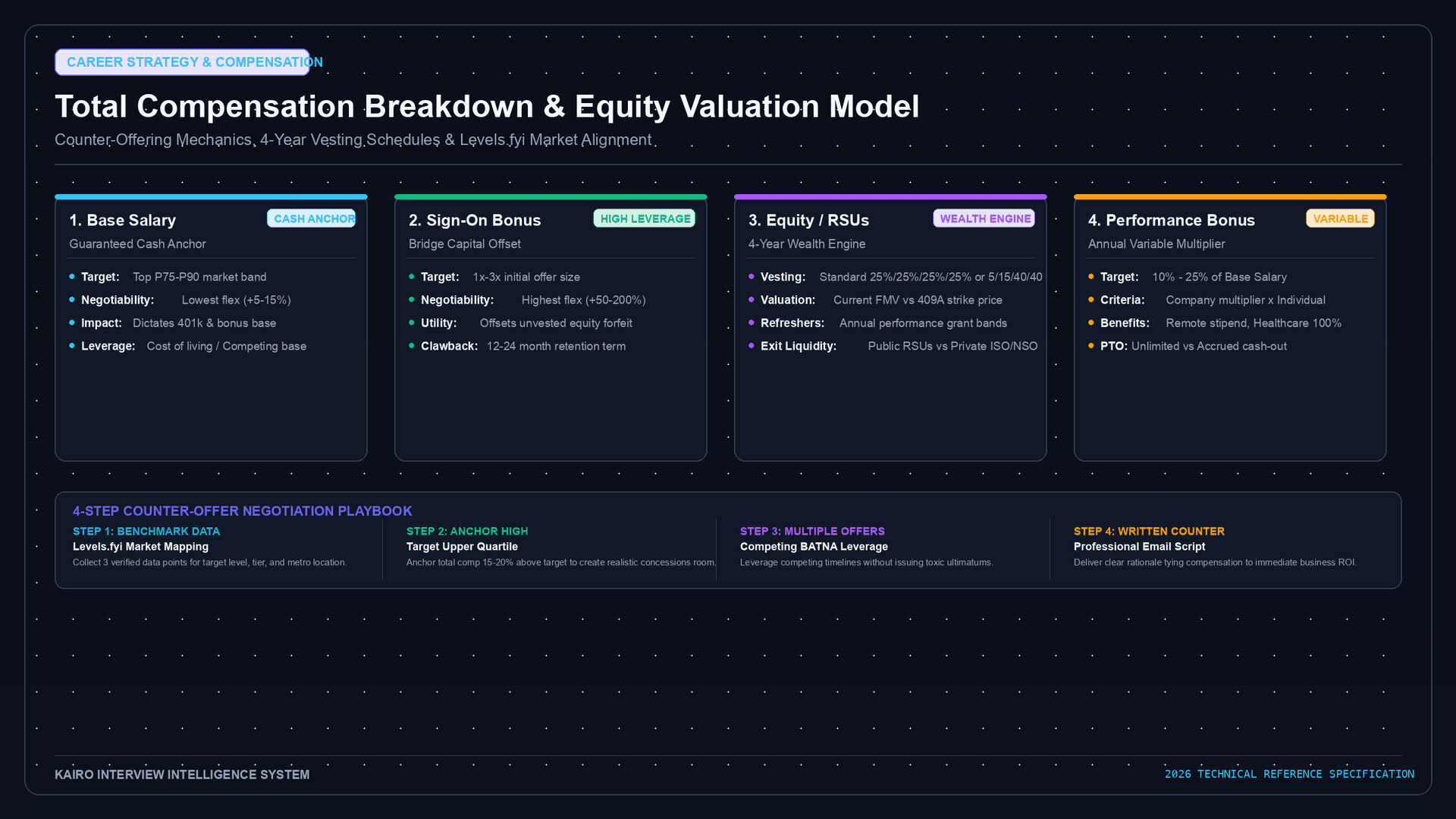
When choosing between a liquid Big Tech compensation package (e.g., $450k total compensation at Meta or Google consisting of base salary, bonus, and publicly traded RSUs) and an early-to-growth stage startup offer (e.g., $210k base salary + 0.35% in stock options), engineers are often presented with inflated spreadsheet projections claiming their equity will be worth millions.
Evaluating startup equity requires looking past recruiter hype and applying rigorous financial math: modeling post-money dilution waterfalls, liquidation preferences, strike price spreads, 83(b) tax liabilities, and Monte Carlo probability distributions of exit outcomes.
This guide provides an exhaustive financial framework for valuing startup options (ISOs and NSOs), modeling future dilution across venture rounds, and comparing risk-adjusted startup packages against liquid Big Tech RSUs.
+───────────────────────────────────────────────────────────────────────────+
|               EQUITY SPECTRUM: LIQUID RSUS VS EARLY-STAGE OPTIONS         |
+───────────────────────────────────────────────────────────────────────────+
|                                                                           |
|   PUBLIC BIG TECH (RSUs):                       SERIES A/B STARTUP (ISOs):|
|   - Guaranteed liquidity (Nasdaq / NYSE)        - Illiquid (5-9 yr lockup)|
|   - Zero exercise cost (Strike Price = $0.00)   - Exercise cost = Strike*N|
|   - Immediate ordinary income taxation on vest  - Complex AMT tax event   |
|   - Low variance, stable expected value ($)     - Power-law distribution  |
|                                                                           |
+───────────────────────────────────────────────────────────────────────────+
1. Deconstructing Startup Equity: The Core Formulas
To value a startup equity offer, you must demand four fundamental data points from the company's finance team or founders:
- Number of Options Granted (
N_shares) - Total Fully Diluted Shares Outstanding (
S_total) - Current 409A Fair Market Value (FMV) Strike Price (
P_strike) - Last Preferred Round Price per Share (
P_pref)
+───────────────────────────────────────────────────────────────────────────+
|                        EQUITY OWNERSHIP FORMULAS                          |
+───────────────────────────────────────────────────────────────────────────+
|                                                                           |
|   1. Fully Diluted Ownership Percentage:                                  |
|      Ownership (%) = (Granted Shares / Fully Diluted Shares) * 100        |
|                                                                           |
|   2. Immediate Exercise Cost:                                             |
|      Cost to Exercise = Granted Shares * Strike Price                     |
|                                                                           |
|   3. Theoretical Paper Value (At Last Preferred Round):                   |
|      Paper Value = Granted Shares * (Preferred Price - Strike Price)      |
|                                                                           |
+───────────────────────────────────────────────────────────────────────────+
The Recruiter "Notional Value" Deception
Recruiters frequently quote your equity as:
V_pitch = N_shares * P_prefThis calculation ignores:
- The cost to exercise (
N_shares * P_strike). - Future dilution across Series B, C, D, and Pre-IPO rounds (15% - 25% per round).
- Liquidation preferences owed to preferred venture investors before common shareholders receive a single dollar.
2. Dilution Waterfalls Across Venture Rounds
Every time a startup raises external venture capital, new shares are minted, diluting the ownership percentage of existing common stockholders.
+───────────────────────────────────────────────────────────────────────────+
|                     4-YEAR STARTUP DILUTION TRAJECTORY                    |
+───────────────────────────────────────────────────────────────────────────+
|                                                                           |
|   [Hire Date: Series A]   Ownership: 0.500%   (100,000 / 20,000,000)      |
|             │                                                             |
|             ▼ (Series B Raise: 20% Dilution + 5% Option Pool Expansion)   |
|   [Year 2: Series B]      Ownership: 0.380%   (Dilution Factor: 0.76)     |
|             │                                                             |
|             ▼ (Series C Raise: 15% Dilution)                              |
|   [Year 3: Series C]      Ownership: 0.323%   (Dilution Factor: 0.85)     |
|             │                                                             |
|             ▼ (Series D / Pre-IPO: 12% Dilution)                          |
|   [Year 4: Series D / IPO]Ownership: 0.284%   (Dilution Factor: 0.88)     |
|                                                                           |
|   FINAL EXIT OWNERSHIP: 0.284% (A 43.2% Reduction from Initial 0.500%)   |
|                                                                           |
+───────────────────────────────────────────────────────────────────────────+
O_final = O_initial * ∏ (1 - D_i)Where D_i represents the dilution fraction of each successive round.
3. Liquidation Preferences & The Payout Waterfall
Venture capitalists purchase Preferred Stock, which carries Liquidation Preferences (usually 1x Non-Participating with standard seniority). In a downside or modest exit, preferred shareholders receive their full invested capital back before common stock (employees) receives anything.
+───────────────────────────────────────────────────────────────────────────+
|                       $100M EXIT WATERFALL SIMULATION                     |
+───────────────────────────────────────────────────────────────────────────+
|                                                                           |
|   Company Raised: $70M Total Capital (Series A + B + C)                   |
|   Acquisition / Exit Price: $100M                                         |
|                                                                           |
|   1. Senior Investor Liquidation Preference:                              |
|      - Preferred VCs claim initial $70M invested capital.                 |
|                                                                           |
|   2. Residual Proceeds Available to Common Stock (Founders & Employees):  |
|      - Remaining Pool = $100M - $70M = $30M                               |
|                                                                           |
|   3. Employee with 0.5% Fully Diluted Stock:                              |
|      - True Payout = 0.5% * $30M = $150,000 (NOT 0.5% * $100M = $500,000!)|
|                                                                           |
+───────────────────────────────────────────────────────────────────────────+
4. Monte Carlo Expected Value (EV) Modeling
Startup outcomes follow a power-law distribution. To objectively compare an illiquid startup offer against a liquid Big Tech offer, run a Monte Carlo Expected Value simulation across 10,000 iterations:
+───────────────────────────────────────────────────────────────────────────+
|               STARTUP EXIT PROBABILITY DISTRIBUTION MATRIX                |
+───────────────────────────────────────────────────────────────────────────+
|                                                                           |
|   Outcome Scenario       | Probability | Valuation at Exit | Employee Val |
+──────────────────────────+─────────────+───────────────────+──────────────+
| 1. Bankruptcy / Zero     |    60.0%    |       $0M         |     $0       |
| 2. Downside Fire-Sale    |    20.0%    |     <$30M (Pref)  |     $0       |
| 3. Modest Acquisition    |    12.0%    |     $80M - $200M  |  $150k - $450k|
| 4. Strong IPO / M&A      |     6.0%    |     $500M - $1.5B |  $1.2M - $3.8M|
| 5. Unicorn Decacorn Exit |     2.0%    |      >$5.0B       |    >$12.0M   |
+──────────────────────────+─────────────+───────────────────+──────────────+
E[V] = ∑ ( P(S_k) * W_k )When computed across standard venture portfolios, the risk-adjusted Expected Value of a 0.25% Series A/B grant is approximately $65,000 to $110,000 per year—far lower than the $200,000+ annual liquid RSU grant provided by tier-1 Big Tech firms.
5. Incentive Stock Options (ISO) vs NSO & AMT Tax Traps
+───────────────────────────────────────────────────────────────────────────+
|                           ISO VS NSO COMPARISON                           |
+───────────────────────────────────────────────────────────────────────────+
|                                                                           |
|   Dimension             | Incentive Stock Options (ISO)| Non-Qualified (NSO)|
+─────────────────────────+──────────────────────────────+────────────────────+
|   Tax on Exercise       | No ordinary tax; triggers AMT| Ordinary Income Tax|
|                         | on spread (FMV - Strike)     | on spread at exercise
|   Holding Period for    | 2 years from grant AND       | 1 year from date   |
|   Long-Term Cap Gains   | 1 year from exercise         | of exercise        |
|   83(b) Election        | Eligible if early exercisable| Eligible           |
+─────────────────────────+──────────────────────────────+────────────────────+
The Alternative Minimum Tax (AMT) Trap
If an employee exercises 50,000 ISOs with a strike price of $0.50 when the 409A FMV is $10.50, they generate a "paper gain" (spread) of: $$S = 50,000 \times (10.50 - 0.50) = $500,000$$
Under the Alternative Minimum Tax (AMT), the IRS treats this $500,000 paper gain as taxable income in the year of exercise, triggering a cash tax bill of $140,000+ on completely illiquid stock that cannot be sold.
6. Offer Negotiation Heuristics
- Trade Salary vs Equity Based on Personal Cash Flow Runway: If joining early-stage, negotiate for early-exercise provisions with an 83(b) election filed within 30 days of grant to lock in negligible AMT liability.
- Demand Double-Trigger Acceleration: Ensure your stock agreement includes double-trigger acceleration (unvested stock immediately vests if the company is acquired AND your role is terminated or demoted).
- Extended Post-Termination Exercise Window (PTEW): Negotiate the standard 90-day exercise window up to 5 to 10 years, preventing you from being forced to forfeit vested options if you leave before an IPO.
Related Salary & Career Negotiation Guides
- How to Negotiate FAANG Software Engineer Salary 2026 — Comprehensive L4-L7 compensation benchmarking and RSU vesting models.
- Salary Negotiation Strategies for Tech Offers — Tactics for competing offers and signing bonuses.
- Kairo Live Interview Preparation — Maximize your offer leveling with an AI interview copilot.