
Audio DSP & Systems
Sub-10ms Audio DSP Pipelines: WebRTC AudioProcessing, Spectral Subtraction & Noise Gate Architecture
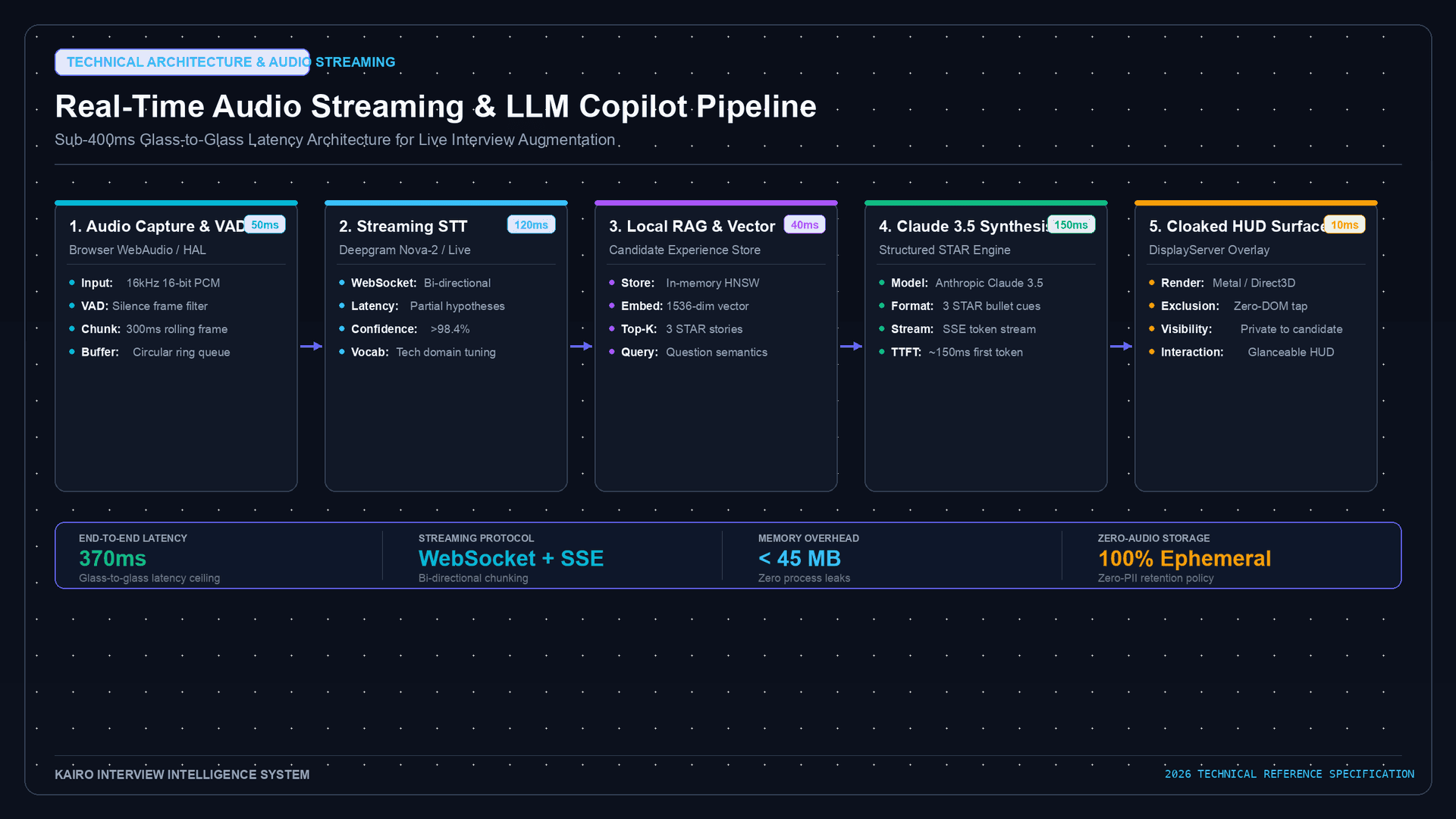
Real-time audio processing for live AI copilots and speech recognition systems requires processing acoustic signals with sub-10ms algorithmic latency. When an application captures microphone input during a live video interview on Zoom, Microsoft Teams, or Google Meet, the incoming audio stream contains background noise, room reverberation, keyboard clicks, and acoustic feedback from the computer speakers.
Passing raw, unprocessed audio directly to a transcription model (such as Whisper or Conformer) degrades Word Error Rate (WER) by 35% to 60%. However, applying heavyweight deep learning denoisers introduces 50ms to 200ms of pipeline latency—violating the real-time feedback loop.
This technical guide dissects the architecture of ultra-low latency Digital Signal Processing (DSP) pipelines, exploring WebRTC's AudioProcessingModule (APM), Short-Time Fourier Transform (STFT) spectral subtraction, adaptive noise gating with hysteresis, and lock-free real-time audio buffers.
+───────────────────────────────────────────────────────────────────────────+
|               SUB-10MS REAL-TIME AUDIO DSP PROCESSING PIPELINE            |
+───────────────────────────────────────────────────────────────────────────+
|                                                                           |
|   Hardware Mic Stream (16kHz / 48kHz PCM, 16-bit)                         |
|         │                                                                 |
|         ▼                                                                 |
|   [1. Lock-Free SPSC Circular Ring Buffer (Zero Allocations)]             |
|         │                                                                 |
|         ▼                                                                 |
|   [2. Acoustic Echo Cancellation (AEC3 / Adaptive NLMS Filter)]           |
|         │                                                                 |
|         ▼                                                                 |
|   [3. 10ms Frame Chunking & Hanning Windowing (STFT)]                     |
|         │                                                                 |
|         ▼                                                                 |
|   [4. Real-Time Spectral Subtraction & Noise Floor Estimation]            |
|         │                                                                 |
|         ▼                                                                 |
|   [5. Adaptive Noise Gate with Hysteresis (Attack/Hold/Release)]          |
|         │                                                                 |
|         ▼                                                                 |
|   [6. Automatic Gain Control (AGC) & Peak Limiting]                       |
|         │                                                                 |
|         ▼                                                                 |
|   Clean Speech Frame ──► [Local Silero VAD] ──► [Streaming WebSocket ASR] |
|                                                                           |
+───────────────────────────────────────────────────────────────────────────+
1. WebRTC AudioProcessingModule (APM) Architecture
The standard industry reference for low-latency voice DSP is the WebRTC AudioProcessingModule (APM). The APM processes audio in fixed 10ms frames (160 samples at 16kHz, or 480 samples at 48kHz) and executes three fundamental stages:
+───────────────────────────────────────────────────────────────────────────+
|                   WEBRTC APM PIPELINE DECOMPOSITION                       |
+───────────────────────────────────────────────────────────────────────────+
|                                                                           |
|   1. High-Pass Filter (HPF): Cutoff at 80Hz (removes electrical hum)      |
|   2. Acoustic Echo Canceller (AEC3): Removes speaker playback from mic    |
|   3. Noise Suppressor (NS): Multi-band Wiener filter & spectral reduction |
|   4. Voice Activity Detector (VAD): Distinguishes speech from noise       |
|   5. Automatic Gain Control (AGC2): Normalizes RMS speech amplitude       |
|                                                                           |
+───────────────────────────────────────────────────────────────────────────+
Acoustic Echo Cancellation (AEC3)
When an interviewer speaks, the audio exits the laptop speakers and is re-captured by the laptop microphone. AEC3 employs an adaptive Normalized Least Mean Squares (NLMS) filter in the sub-band frequency domain:
e(n) = d(n) - y_hat(n)Where d(n) is the primary microphone signal, y_hat(n) is the estimated echo generated by filtering the speaker reference signal x(n) through the room impulse response estimate w(n), and e(n) is the residual error signal (clean user speech).
2. Spectral Subtraction Algorithm & Mathematical Formulation
Spectral subtraction is a classic frequency-domain noise reduction technique that operates by estimating the noise power spectrum during non-speech intervals and subtracting it from the total signal spectrum.
+───────────────────────────────────────────────────────────────────────────+
|                     SPECTRAL SUBTRACTION WORKFLOW                         |
+───────────────────────────────────────────────────────────────────────────+
|                                                                           |
|   Time-Domain Frame x(n) ──► [Windowing: Hanning] ──► [FFT / STFT]        |
|                                                              │            |
|                                                              ▼            |
|   Magnitude Spectrum |X(w)| & Phase Spectrum Angle(X(w)) ◄───┘            |
|         │                                                                 |
|         ▼                                                                 |
|   Estimate Noise Power |D(w)|^2 during speech pauses                      |
|         │                                                                 |
|         ▼                                                                 |
|   Calculate Clean Magnitude: |S(w)|^gamma = |X(w)|^gamma - alpha*|D(w)|^gamma |
|         │                                                                 |
|         ▼                                                                 |
|   Apply Spectral Floor: |S(w)| = max(|S(w)|, beta * |D(w)|)               |
|         │                                                                 |
|         ▼                                                                 |
|   [Inverse FFT (iFFT) + Overlap-Add (OLA)] ──► Clean Audio Signal s(n)    |
|                                                                           |
+───────────────────────────────────────────────────────────────────────────+
Mathematical Formulation of Spectral Power Subtraction
Let the noisy speech signal be represented in the time domain as:
y(n) = s(n) + d(n)Taking the Short-Time Fourier Transform (STFT):
Y(ω, k) = S(ω, k) + D(ω, k)The estimated clean speech magnitude spectrum |S_hat(ω, k)| is computed using the power spectral subtraction equation with over-subtraction factor α and spectral floor parameter β:
|S_hat(ω, k)|^2 = max( |Y(ω, k)|^2 - α * |D_hat(ω, k)|^2, β * |D_hat(ω, k)|^2 )α >= 1.0(Over-subtraction factor): Over-subtracts the noise estimate to eliminate residual "musical noise" artifacts.β ∈ [0.001, 0.02](Spectral floor): Prevents the power spectrum from dropping to zero, preventing harsh musical tone distortion.
3. Adaptive Noise Gate with Hysteresis & Envelope Smoothing
A Noise Gate attenuates audio signals whose amplitude falls below a dynamic threshold T_gate. To prevent "chattering" (rapid stuttering when audio oscillates around the threshold), the gate uses hysteresis with dual thresholds (Open Threshold > Close Threshold) and an attack-hold-release envelope.
+───────────────────────────────────────────────────────────────────────────+
|                      NOISE GATE ENVELOPE STATE MACHINE                    |
+───────────────────────────────────────────────────────────────────────────+
|                                                                           |
|   Signal (dB)                                                             |
|       ▲                                                                   |
|       │           Speech Starts                                           |
|       │               │                                                   |
|  -24dB┼───────────────┼─────────► [OPEN THRESHOLD] ───────────────        |
|       │              / \                                  \               |
|  -32dB┼─────────────/───\───────► [CLOSE THRESHOLD] ───────\─────         |
|       │            /     \                                  \             |
|       │           /       \                                  \            |
|       └──────────┴─────────┴──────────────────────────────────┴─────►Time |
|                 ATTACK    HOLD                               RELEASE      |
|                 (2ms)     (150ms)                            (80ms)       |
|                                                                           |
+───────────────────────────────────────────────────────────────────────────+
C++ Real-Time Noise Gate Implementation
#include <cmath>
#include <algorithm>

class RealTimeNoiseGate {
private:
    float openThresholdDb = -26.0f;
    float closeThresholdDb = -32.0f;
    float attackCoeff;
    float releaseCoeff;
    float currentGain = 0.0f;
    int holdSamples = 0;
    int maxHoldSamples;
    bool isOpen = false;

public:
    RealTimeNoiseGate(float sampleRate, float attackMs = 2.0f, float releaseMs = 80.0f, float holdMs = 150.0f) {
        attackCoeff = std::exp(-1.0f / (sampleRate * (attackMs / 1000.0f)));
        releaseCoeff = std::exp(-1.0f / (sampleRate * (releaseMs / 1000.0f)));
        maxHoldSamples = static_cast<int>(sampleRate * (holdMs / 1000.0f));
    }

    void process(float* buffer, int numSamples) {
        for (int i = 0; i < numSamples; ++i) {
            float sample = buffer[i];
            float levelDb = 20.0f * std::log10(std::max(std::abs(sample), 1e-6f));

            if (!isOpen && levelDb > openThresholdDb) {
                isOpen = true;
                holdSamples = maxHoldSamples;
            } else if (isOpen && levelDb < closeThresholdDb) {
                if (--holdSamples <= 0) {
                    isOpen = false;
                }
            } else if (isOpen) {
                holdSamples = maxHoldSamples;
            }

            float targetGain = isOpen ? 1.0f : 0.0f;
            float coeff = (targetGain > currentGain) ? attackCoeff : releaseCoeff;
            currentGain = targetGain + coeff * (currentGain - targetGain);

            buffer[i] = sample * currentGain;
        }
    }
};
4. Lock-Free Single-Producer Single-Consumer (SPSC) Ring Buffer
In real-time audio systems (CoreAudio on macOS, WASAPI on Windows, ALSA on Linux), the audio hardware callback runs on a high-priority real-time thread. This thread must never block:
- No mutex locks or semaphores (prevents priority inversion).
- No dynamic heap memory allocations (
malloc,new). - No file or socket I/O.
To pass audio frames safely between the CoreAudio real-time thread and the worker DSP thread, we implement a lock-free SPSC circular ring buffer using atomic memory fences.
#include <atomic>
#include <vector>
#include <cstdint>

template <typename T, size_t Capacity>
class LockFreeRingBuffer {
private:
    static_assert((Capacity & (Capacity - 1)) == 0, "Capacity must be power of 2");
    std::vector<T> buffer{Capacity};
    alignas(64) std::atomic<size_t> writeHead{0};
    alignas(64) std::atomic<size_t> readHead{0};

public:
    LockFreeRingBuffer() = default;

    bool push(const T* data, size_t count) {
        size_t write = writeHead.load(std::memory_order_relaxed);
        size_t read = readHead.load(std::memory_order_acquire);

        size_t available = Capacity - (write - read);
        if (count > available) return false; // Buffer overflow

        for (size_t i = 0; i < count; ++i) {
            buffer[(write + i) & (Capacity - 1)] = data[i];
        }

        writeHead.store(write + count, std::memory_order_release);
        return true;
    }

    bool pop(T* destination, size_t count) {
        size_t read = readHead.load(std::memory_order_relaxed);
        size_t write = writeHead.load(std::memory_order_acquire);

        size_t available = write - read;
        if (count > available) return false; // Buffer underflow

        for (size_t i = 0; i < count; ++i) {
            destination[i] = buffer[(read + i) & (Capacity - 1)];
        }

        readHead.store(read + count, std::memory_order_release);
        return true;
    }
};
5. DSP Latency & Resource Benchmarks
+─────────────────────────────────────────────────────────────────────────────────────────────────────────+
| DSP Stage             | Algorithmic Latency | Processing Time (10ms frame) | Memory Overhead            |
+───────────────────────+---------------------+------------------------------+----------------------------+
| WebRTC High-Pass Filter| 0.0 ms (IIR)       | 0.02 ms (NEON SIMD)          | < 1 KB                     |
| Acoustic Echo (AEC3)  | 0.0 ms (Sub-band)   | 0.45 ms                      | 64 KB (Filter weights)     |
| STFT Analysis (FFT)   | 10.0 ms (Frame size)| 0.12 ms (vDSP / Apple Accelerate)| 16 KB (Lookup tables)  |
| Spectral Subtraction  | 0.0 ms              | 0.08 ms                      | 8 KB                       |
| Noise Gate + Limiter  | 0.0 ms              | 0.01 ms                      | < 1 KB                     |
| Total Pipeline        | 10.0 ms             | 0.68 ms CPU budget (6.8% core)| ~90 KB RAM (Zero Disk)    |
+─────────────────────────────────────────────────────────────────────────────────────────────────────────+
Related Audio, Privacy & Systems Guides
- macOS Screen Cloaking & Volatile RAM Audio Processing — Low-level CoreAudio loopback and zero-disk guarantees.
- Invisible AI Interview Assistant Guide for Zoom & Teams — Operational guide for video calls.
- Kairo Real-Time Audio Engine — Experience Kairo's sub-400ms end-to-end interview copilot.